Great Revolution in England | Glorious Revolution | World history PSC Notes
Glorious Revolution / Bloodless Revolution — 1688
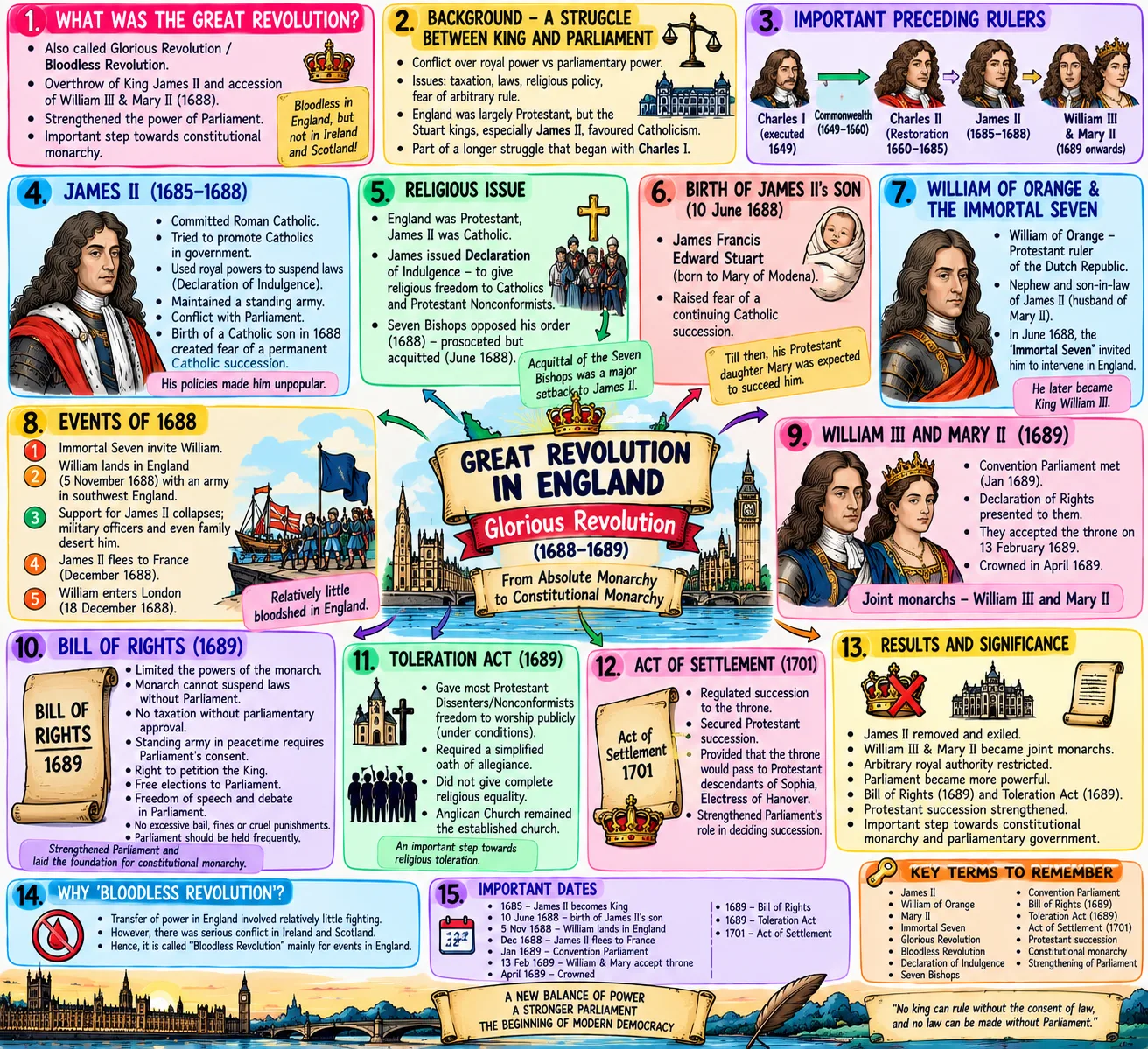
Q1. What was the Great Revolution in England, and by what other names is it known?
Answer:
- The Great Revolution in England generally refers to the Glorious Revolution of 1688–1689.
- It resulted in:
- The overthrow and exile of King James II
- The accession of William III (William of Orange) and Mary II
- A major strengthening of Parliament's authority over the monarchy
- It is commonly known as:
- Glorious Revolution
- Bloodless Revolution
- Revolution of 1688
It is called “Bloodless” because the transfer of power in England involved relatively little bloodshed. However, the wider revolution was not bloodless in Ireland and Scotland.
1. BACKGROUND — THE STUART MONARCHY
Q2. What was the basic political conflict behind the Great Revolution?
Answer:
The fundamental conflict was over the relationship between the monarchy and Parliament.
Important issues included:
- Extent of the King's powers
- Authority of Parliament
- Taxation and laws
- Religious policy
- Fear of arbitrary or absolute monarchy
- Conflict between Catholicism and Protestantism
The Revolution eventually established more firmly that the monarch could not govern independently of Parliament.
Q3. Which rulers immediately preceded the Glorious Revolution?
Answer:
Remember the sequence:
Charles I → Commonwealth/Protectorate → Charles II → James II → William III & Mary II
Important points:
- Charles I was executed in 1649 following the English Civil War.
- Monarchy was restored in 1660 under Charles II.
- This is known as the Restoration.
- Charles II died in 1685.
- His brother James II became King in 1685.
- James II's reign ultimately produced the crisis that led to the Glorious Revolution.
2. JAMES II
Q4. Who was James II, and why did his rule become unpopular?
Answer:
James II:
- Became King in 1685.
- Was a committed Roman Catholic.
- Ruled a country in which Protestantism was dominant.
Opposition developed because of fears concerning:
- His Catholic religious policies
- His use of royal prerogative
- His attempts to suspend or dispense with laws
- His attempts to give Catholics greater access to public offices
- His maintenance of a standing army
- His attempts to exercise authority without sufficient parliamentary control
His policies created fears of both Catholic domination and arbitrary monarchy.
3. RELIGIOUS ISSUE
Q5. Why was religion an important cause of the Glorious Revolution?
Answer:
England was predominantly Protestant, while James II was a Catholic monarch.
James:
- Gave Catholics greater religious freedom.
- Allowed Catholics to hold important positions.
- Used royal powers to bypass restrictions imposed by existing laws.
- Tried to promote greater religious toleration through the Declaration of Indulgence.
Many opponents believed his policies threatened:
- The Church of England
- Protestant succession
- The authority of Parliament.
Q6. What was the Declaration of Indulgence, and how did it contribute to the crisis?
Answer:
James II issued a Declaration of Indulgence.
Its purpose included relaxing religious restrictions on:
- Catholics
- Protestant Nonconformists/Dissenters
However, an important issue was how James exercised this power.
- He claimed the royal power to suspend laws.
- This increased fears that the King could override laws without Parliament.
- In 1688, seven bishops opposed his order concerning the Declaration.
- James prosecuted the Seven Bishops.
- They were acquitted in June 1688.
Their acquittal was a major political setback for James II.
4. BIRTH OF JAMES II'S SON
Q7. Why was the birth of James II's son in 1688 a turning point?
Answer:
Before 1688:
- James II's Protestant daughter Mary was expected to succeed him.
- Mary was married to the Protestant William of Orange.
But on 10 June 1688:
- James II and his Catholic wife Mary of Modena had a son.
- His name was James Francis Edward Stuart.
This created the possibility of a continuing Catholic royal succession.
The birth greatly increased Protestant fears and helped trigger the political crisis that led to the Revolution.
5. WILLIAM OF ORANGE AND THE “IMMORTAL SEVEN”
Q8. Who was William of Orange, and what was his relationship with James II?
Answer:
William of Orange:
- Protestant ruler from the Dutch Republic.
- Also known as William, Prince of Orange.
- He was both the nephew and son-in-law of James II.
- He was married to Mary, James II's Protestant daughter.
He later became:
King William III of England.
Q9. Who were the “Immortal Seven,” and what did they do?
Answer:
The Immortal Seven were seven prominent Englishmen who opposed James II.
In June 1688, they invited William of Orange to intervene in England.
Their concerns included:
- Preservation of Protestantism
- James II's policies
- The new Catholic succession
- Need for a free Parliament
Their invitation helped set William's invasion in motion.
6. GLORIOUS REVOLUTION — 1688
Q10. What happened during the Glorious Revolution of 1688?
Answer:
The main sequence was:
1. William invited
- The Immortal Seven invited William of Orange to intervene.
2. William landed in England
- Date: 5 November 1688
- He landed with an army in southwest England.
3. Support for James II collapsed
- Important military officers and political supporters deserted James.
- Even members of his family moved towards William's side.
4. James II fled
- James attempted to escape.
- He eventually fled successfully to France in December 1688.
5. William entered London
- William reached London on 18 December 1688.
A Convention Parliament was then summoned to determine the political settlement.
7. WILLIAM III AND MARY II
Q11. How did William and Mary become rulers of England?
Answer:
After James II fled:
- A Convention Parliament met in January 1689.
- Parliament worked out a new political settlement.
- The Declaration of Rights was presented to William and Mary.
- They accepted the throne on 13 February 1689.
- William and Mary became joint monarchs.
- They were crowned in April 1689.
Thus:
James II → removed/exiled
William III + Mary II → joint sovereigns.
8. BILL OF RIGHTS — 1689
Q12. What was the Bill of Rights of 1689, and why was it important?
Answer:
The Bill of Rights, 1689 was one of the most important results of the Glorious Revolution.
It developed from the Declaration of Rights presented to William and Mary.
Its purpose was to:
- Limit arbitrary royal power
- Protect the powers of Parliament
- Establish important rights and liberties
- Regulate the relationship between the Crown and Parliament
It became a landmark in the development of constitutional monarchy and parliamentary government in England.
Q13. What were the important provisions of the Bill of Rights?
Answer:
Important principles included:
- The monarch could not suspend laws without Parliament.
- The monarch could not levy money/taxes for the Crown without parliamentary authorization.
- A standing army in peacetime required Parliament's consent.
- Subjects had the right to petition the King.
- Elections to Parliament should be free.
- Freedom of speech and debate in Parliament was protected.
- Excessive bail and excessive fines should not be imposed.
- Cruel and unusual punishments were prohibited.
- Parliament should be held frequently.
These restrictions significantly strengthened Parliament against arbitrary royal authority.
9. TOLERATION ACT — 1689
Q14. What was the Toleration Act of 1689?
Answer:
The Toleration Act was passed by Parliament in 1689, during the reign of William and Mary.
It:
- Gave most Protestant Dissenters/Nonconformists freedom to worship publicly under specified conditions.
- Required them to take a simplified oath of allegiance.
- Did not establish complete religious equality.
- Dissenters continued to face other restrictions.
It marked an important stage in the gradual extension of religious toleration and civil rights beyond the established Anglican Church.
10. CONSTITUTIONAL MONARCHY
Q16. How did the Glorious Revolution change the nature of monarchy in England?
Answer:
The Revolution was a major step towards constitutional monarchy.
After the Revolution:
- Monarchs could not govern independently of Parliament in the manner attempted by James II.
- Parliament acquired a stronger position in:
- Law-making
- Taxation
- Control of government finances
- Military matters
- Royal succession
- The Crown was increasingly governed within a framework of law and parliamentary consent.
The Revolution is therefore considered a major turning point in the development of the British constitutional system and parliamentary sovereignty.
11. ACT OF SETTLEMENT
Q17. What was the Act of Settlement, and how was it connected to the Glorious Revolution?
Answer:
The constitutional settlement continued after 1689.
The Act of Settlement 1701:
- Further regulated succession to the English throne.
- Helped secure a Protestant succession.
- Provided that succession would pass through the Protestant descendants of Sophia, Electress of Hanover, under its provisions.
It strengthened Parliament's role in determining the succession to the Crown.
12. MAJOR RESULTS
Q18. What were the major results and significance of the Great Revolution?
Answer:
The important results were:
- James II was removed from power.
- William III and Mary II became joint monarchs.
- Arbitrary royal authority was restricted.
- Parliament became more powerful in relation to the Crown.
- Bill of Rights, 1689 established important constitutional principles.
- Toleration Act, 1689 granted limited religious toleration to many Protestant dissenters.
- Protestant succession was strengthened.
- England moved further towards a constitutional monarchy.
- Parliament's role in taxation, legislation, the military and succession was strengthened.
- It became a major landmark in the historical development of parliamentary government.
13. WHY “BLOODLESS REVOLUTION”?
Q19. Why is the Glorious Revolution called the “Bloodless Revolution”?
Answer:
It is traditionally called the Bloodless Revolution because the change of regime in England in 1688 involved relatively little fighting.
The wider struggle involved serious conflict in:
- Ireland
- Scotland
Therefore, “Bloodless Revolution” is a conventional name mainly referring to the English transfer of power.
14. IMPORTANT PEOPLE
Q20. Who are the personalities that should be connected with the Great Revolution?
Answer:
James II
- Catholic King whose policies produced the immediate crisis.
- Fled to France in 1688.
William of Orange
- Protestant Dutch ruler.
- Husband and nephew of James II's daughter Mary.
- Invited to England.
- Became William III.
Mary II
- Protestant daughter of James II.
- Wife of William of Orange.
- Became joint monarch with William.
Mary of Modena
- Catholic wife of James II.
- Gave birth to James Francis Edward Stuart in 1688.
Immortal Seven
- Invited William of Orange to intervene in England.