Linguistic Reorganisation of States in India – Kerala PSC Notes
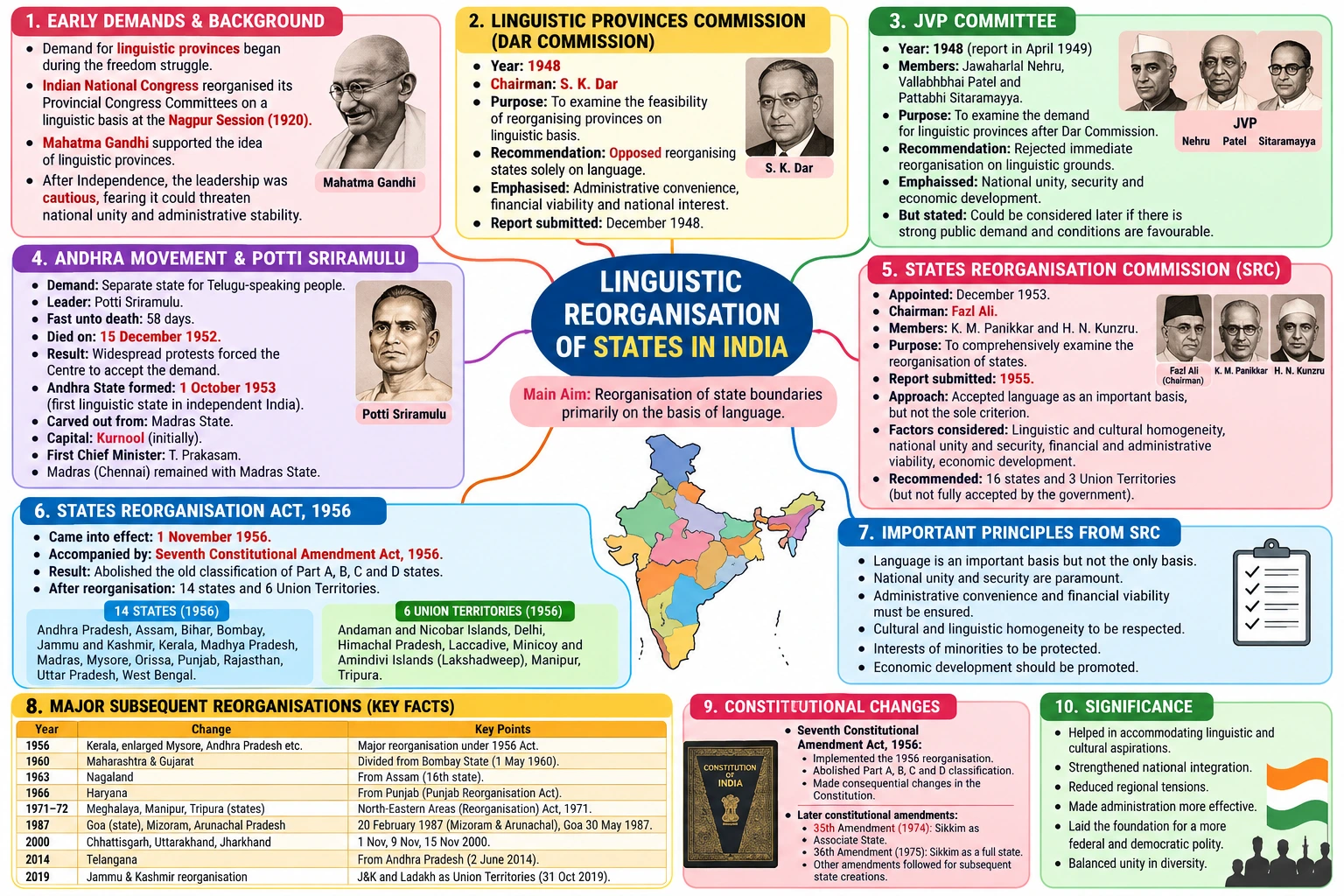
Background
Q: What is meant by the linguistic reorganisation of states?
A: Reorganisation of state boundaries primarily on the basis of the language spoken by the majority of the population.
Q: Which organisation first strongly promoted the idea of linguistic provinces during the freedom struggle?
A: Indian National Congress.
Q: At which session did the Indian National Congress reorganise its Provincial Congress Committees on a linguistic basis?
A: Nagpur Session, 1920.
Q: Who was a major early advocate of linguistic provinces in India?
A: Mahatma Gandhi.
Q: Why did the national leadership become cautious about linguistic states after Independence?
A: It feared that linguistic divisions could threaten national unity and administrative stability immediately after Partition.
Linguistic Provinces Commission — Dar Commission
Q: When was the Linguistic Provinces Commission appointed?
A: 1948.
Q: What was another name for the Linguistic Provinces Commission of 1948?
A: Dar Commission.
Q: Who chaired the Linguistic Provinces Commission?
A: S. K. Dar.
Q: What was the purpose of the Dar Commission?
A: To examine the feasibility of reorganising provinces on a linguistic basis.
Q: What did the Dar Commission recommend regarding linguistic states?
A: It opposed reorganising states solely on the basis of language.
Q: What factors did the Dar Commission consider more important than language?
A: Administrative convenience, financial viability and national interest.
Q: When did the Dar Commission submit its report?
A: December 1948.
JVP Committee
Q: Which committee was formed after the Dar Commission to examine the issue of linguistic provinces?
A: JVP Committee.
Q: When was the JVP Committee appointed?
A: 1948.
Q: What does JVP stand for?
A: Jawaharlal Nehru, Vallabhbhai Patel and Pattabhi Sitaramayya.
Q: Who were the members of the JVP Committee?
A: Jawaharlal Nehru, Vallabhbhai Patel and Pattabhi Sitaramayya.
Q: When did the JVP Committee submit its report?
A: April 1949.
Q: What was the JVP Committee's position on linguistic reorganisation?
A: It rejected the immediate reorganisation of states solely on linguistic grounds.
Q: What did the JVP Committee consider more important than linguistic demands?
A: National unity, security and economic development.
Q: Did the JVP Committee completely rule out linguistic states forever?
A: No. It held that linguistic reorganisation could be considered later if there was strong public demand and other conditions were favourable.
Andhra Movement and Potti Sriramulu
Q: Which movement became the immediate catalyst for linguistic reorganisation in India?
A: Movement for a separate Telugu-speaking Andhra State.
Q: From which state was Andhra State carved out?
A: Madras State.
Q: Who undertook a fast unto death demanding a separate Andhra State?
A: Potti Sriramulu.
Q: What was Potti Sriramulu demanding?
A: A separate state for Telugu-speaking people.
Q: How long did Potti Sriramulu's fast last before his death?
A: 58 days.
Q: When did Potti Sriramulu die?
A: 15 December 1952.
Q: What happened after the death of Potti Sriramulu?
A: Widespread protests forced the Union government to accept the demand for a separate Andhra State.
Q: When was Andhra State formed?
A: 1 October 1953.
Q: What was the significance of Andhra State?
A: It was the first state created on a linguistic basis in independent India.
Q: What was the capital of Andhra State when it was created in 1953?
A: Kurnool.
Q: Who became the first Chief Minister of Andhra State?
A: Tanguturi Prakasam (T. Prakasam).
Q: Which city remained with Madras State despite demands to include it in Andhra?
A: Madras (Chennai).
Q: What slogan became associated with the Telugu claim over Madras city?
A: "Madras Manade" (Madras is ours).
Q: Was Tamil Nadu created as a new state in 1953 along with Andhra?
A: No. Andhra State was separated from the existing Madras State in 1953; Madras State was renamed Tamil Nadu only in 1969.
States Reorganisation Commission (SRC)
Q: When was the States Reorganisation Commission appointed?
A: December 1953.
Q: Why was the States Reorganisation Commission appointed?
A: To comprehensively examine the reorganisation of India's states after growing demands for linguistic states.
Q: Who was the chairman of the States Reorganisation Commission?
A: Fazl Ali.
Q: Who were the three members of the States Reorganisation Commission?
A: Fazl Ali, K. M. Panikkar and H. N. Kunzru.
Q: Which Malayali historian and diplomat was a member of the States Reorganisation Commission?
A: K. M. Panikkar.
Q: When did the States Reorganisation Commission submit its report?
A: 1955.
Q: Did the SRC accept language as the sole criterion for state reorganisation?
A: No.
Q: What factors did the SRC consider while recommending state boundaries?
A: Linguistic and cultural homogeneity, national unity and security, financial and administrative viability, and economic development.
Q: What was the SRC's general approach towards linguistic states?
A: It accepted language as an important basis for reorganisation but subordinated it to national unity and administrative and economic considerations.
Q: How many states and centrally administered territories did the SRC originally recommend?
A: 16 states and 3 centrally administered territories.
Q: Were all recommendations of the SRC accepted by the Government of India?
A: No.
States Reorganisation Act, 1956
Q: Which major law implemented the large-scale reorganisation of Indian states?
A: States Reorganisation Act, 1956.
Q: Which constitutional amendment accompanied the States Reorganisation Act, 1956?
A: Seventh Constitutional Amendment Act, 1956.
Q: When did the States Reorganisation Act, 1956 come into effect?
A: 1 November 1956.
Q: How many states and Union Territories existed after the 1956 reorganisation?
A: 14 states and 6 Union Territories.
Q: What happened to the old classification of Part A, Part B, Part C and Part D states in 1956?
A: It was abolished.
Q: Which constitutional amendment abolished the distinction between Part A, B, C and D states?
A: Seventh Constitutional Amendment Act, 1956.
14 States after the 1956 Reorganisation
Q: Name the 14 states created/recognised following the States Reorganisation Act, 1956.
A: Andhra Pradesh, Assam, Bihar, Bombay, Jammu and Kashmir, Kerala, Madhya Pradesh, Madras, Mysore, Orissa, Punjab, Rajasthan, Uttar Pradesh and West Bengal.
6 Union Territories
Q: Name the six Union Territories after the 1956 reorganisation.
A: Andaman and Nicobar Islands, Delhi, Himachal Pradesh, Laccadive, Minicoy and Amindivi Islands, Manipur and Tripura.
Q: What is the present name of the Laccadive, Minicoy and Amindivi Islands?
A: Lakshadweep.
Formation of Andhra Pradesh
Q: When was Andhra Pradesh formed?
A: 1 November 1956.
Q: How was Andhra Pradesh formed in 1956?
A: By merging Andhra State with the Telugu-speaking Telangana region of Hyderabad State.
Q: What was the capital of the newly formed Andhra Pradesh in 1956?
A: Hyderabad.
Q: What was the agreement associated with the merger of Telangana and Andhra in 1956?
A: Gentlemen's Agreement.
Q: What was significant about Andhra Pradesh after its formation in 1956?
A: It became the first major state formed by combining Telugu-speaking regions under the States Reorganisation Act.
Formation of Kerala
Q: When was Kerala formed?
A: 1 November 1956.
Q: Kerala was formed primarily on what basis?
A: Malayalam language.
Q: Which regions were primarily combined to form Kerala?
A: Travancore-Cochin and the Malabar district of Madras State.
Q: Which taluk of South Kanara district was added to Kerala in 1956?
A: Kasaragod taluk.
Q: Which Malayalam-speaking region of Madras State became part of Kerala?
A: Malabar district.
Q: Which regions of Travancore-Cochin were transferred to Madras State in 1956?
A: Agastheeswaram, Thovala, Kalkulam and Vilavancode taluks, along with part of Shencottah (Shenkottai) taluk.
Q: The four southern taluks transferred from Travancore-Cochin became part of which district?
A: Kanyakumari district.
Q: Why were the Kanyakumari areas transferred from Travancore-Cochin to Madras State?
A: They had a predominantly Tamil-speaking population.
Q: Which movement demanded the merger of Tamil-speaking areas of Travancore-Cochin with Madras State?
A: Travancore Tamil Nadu Congress movement.
Q: Who was a prominent leader of the Travancore Tamil Nadu Congress?
A: A. Nesamony.
Q: What is celebrated in Kerala on 1 November?
A: Kerala Piravi.
Other Major Changes in 1956
Q: Which state was substantially enlarged by bringing together Kannada-speaking areas in 1956?
A: Mysore State.
Q: When was Mysore State renamed Karnataka?
A: 1973.
Q: Which bilingual state containing Marathi- and Gujarati-speaking regions was created in 1956?
A: Bombay State.
Q: Which former princely state was divided among neighbouring states in the 1956 reorganisation?
A: Hyderabad State.
Q: What happened to Hyderabad State during the 1956 reorganisation?
A: Its Telugu-speaking Telangana region joined Andhra Pradesh, while Marathi-speaking and Kannada-speaking areas were merged with Bombay and Mysore respectively.
Maharashtra and Gujarat — 1960
Q: Which movement demanded a separate Marathi-speaking state?
A: Samyukta Maharashtra Movement.
Q: Which movement demanded a separate Gujarati-speaking state?
A: Mahagujarat Movement.
Q: Which state was divided to create Maharashtra and Gujarat?
A: Bombay State.
Q: When were Maharashtra and Gujarat formed?
A: 1 May 1960.
Q: Bombay city became the capital of which state?
A: Maharashtra.
Q: Which day is celebrated as Maharashtra Day and Gujarat Day?
A: 1 May.
Nagaland — 1963
Q: Which state was created from Assam in 1963?
A: Nagaland.
Q: When did Nagaland become a state?
A: 1 December 1963.
Q: What number state of the Indian Union was Nagaland?
A: 16th state.
Punjab Reorganisation — 1966
Q: Which linguistic movement led to the reorganisation of Punjab?
A: Punjabi Suba Movement.
Q: What did the Punjabi Suba Movement demand?
A: A Punjabi-speaking state.
Q: Which political organisation was closely associated with the Punjabi Suba demand?
A: Shiromani Akali Dal.
Q: Which Act reorganised Punjab in 1966?
A: Punjab Reorganisation Act, 1966.
Q: When did the reorganisation of Punjab take effect?
A: 1 November 1966.
Q: Which new state was created from Punjab in 1966?
A: Haryana.
Q: What was the principal linguistic basis for separating Haryana from Punjab?
A: Haryana was predominantly Hindi-speaking, while reorganised Punjab was predominantly Punjabi-speaking.
Q: What happened to Chandigarh after the Punjab reorganisation?
A: It became a Union Territory and the joint capital of Punjab and Haryana.
Q: Which areas of Punjab were transferred to Himachal Pradesh in 1966?
A: Certain hill areas.
Himachal Pradesh
Q: When did Himachal Pradesh become a full-fledged state?
A: 25 January 1971.
Q: What number state of India was Himachal Pradesh?
A: 18th state.
North-Eastern Reorganisation
Q: Which Act was responsible for a major reorganisation of Northeast India in the early 1970s?
A: North-Eastern Areas (Reorganisation) Act, 1971.
Q: When did Meghalaya, Manipur and Tripura become full-fledged states?
A: 21 January 1972.
Q: Which state was originally created as an autonomous state within Assam in 1970?
A: Meghalaya.
Q: Which two former Union Territories became states in 1972?
A: Manipur and Tripura.
Q: Which two Union Territories were created under the North-Eastern Areas (Reorganisation) Act?
A: Mizoram and Arunachal Pradesh (then called the North-East Frontier Agency before becoming a UT).
Sikkim
Q: Which constitutional amendment made Sikkim an Associate State of India?
A: 35th Constitutional Amendment Act, 1974.
Q: Which constitutional amendment made Sikkim a full state of India?
A: 36th Constitutional Amendment Act, 1975.
Q: When did Sikkim become a full-fledged state of India?
A: 16 May 1975.
Q: What number state of India was Sikkim?
A: 22nd state.
Mizoram and Arunachal Pradesh
Q: When did Mizoram become a state?
A: 20 February 1987.
Q: When did Arunachal Pradesh become a state?
A: 20 February 1987.
Q: What number state of India was Mizoram?
A: 23rd state.
Q: What number state of India was Arunachal Pradesh?
A: 24th state.
Goa
Q: When was Goa liberated from Portuguese rule?
A: 19 December 1961.
Q: Which military operation led to the liberation of Goa?
A: Operation Vijay.
Q: Which territories were incorporated into India following the end of Portuguese rule in 1961?
A: Goa, Daman and Diu.
Q: When did Goa become a state?
A: 30 May 1987.
Q: What number state of India was Goa?
A: 25th state.
Q: What happened to Daman and Diu when Goa became a state?
A: Daman and Diu remained a Union Territory.
Creation of Three States in 2000
Q: Which three new states were created in 2000?
A: Chhattisgarh, Uttarakhand and Jharkhand.
Q: From which state was Chhattisgarh created?
A: Madhya Pradesh.
Q: When was Chhattisgarh formed?
A: 1 November 2000.
Q: From which state was Uttarakhand created?
A: Uttar Pradesh.
Q: When was Uttarakhand formed?
A: 9 November 2000.
Q: What was Uttarakhand originally called when it became a state?
A: Uttaranchal.
Q: When was Uttaranchal renamed Uttarakhand?
A: 2007.
Q: From which state was Jharkhand created?
A: Bihar.
Q: When was Jharkhand formed?
A: 15 November 2000.
Telangana — 2014
Q: Which is the most recently created state of India?
A: Telangana.
Q: From which state was Telangana created?
A: Andhra Pradesh.
Q: When was Telangana formed?
A: 2 June 2014.
Q: Which Act created Telangana?
A: Andhra Pradesh Reorganisation Act, 2014.
Q: What number state of India is Telangana?
A: 29th state at the time of its formation.
Q: Which city was designated as the common capital of Telangana and Andhra Pradesh for a transitional period?
A: Hyderabad.
Jammu and Kashmir Reorganisation — 2019
Q: Which Act reorganised the former state of Jammu and Kashmir?
A: Jammu and Kashmir Reorganisation Act, 2019.
Q: When did the Jammu and Kashmir Reorganisation Act take effect?
A: 31 October 2019.
Q: Into which two Union Territories was the former state of Jammu and Kashmir reorganised?
A: Jammu and Kashmir, and Ladakh.
Q: Which of the two Union Territories created in 2019 has a legislature?
A: Jammu and Kashmir.
Q: Which Union Territory created in 2019 does not have a legislature?
A: Ladakh.
Q: How many states does India have after the Jammu and Kashmir reorganisation?
A: 28.
Q: How many Union Territories does India currently have?
A: 8.
Important Commissions & Committees — Rapid Recall
Q: Dar Commission is associated with what?
A: Linguistic reorganisation of provinces.
Q: Who chaired the Dar Commission?
A: S. K. Dar.
Q: JVP Committee is associated with what?
A: Examination of the demand for linguistic provinces.
Q: Who were JVP?
A: Jawaharlal Nehru, Vallabhbhai Patel and Pattabhi Sitaramayya.
Q: Fazl Ali Commission is another name for which commission?
A: States Reorganisation Commission.
Q: Who chaired the States Reorganisation Commission?
A: Fazl Ali.
Q: Who were the other two SRC members?
A: K. M. Panikkar and H. N. Kunzru.
Q: Arrange these in chronological order: JVP Committee, SRC, Dar Commission.
A: Dar Commission (1948) → JVP Committee (1948–49) → SRC (1953–55).
High-Yield Chronology
Q: Arrange the major linguistic reorganisation developments chronologically.
A: Dar Commission (1948) → JVP Committee (1948–49) → Potti Sriramulu's death (1952) → Andhra State (1953) → SRC appointed (1953) → SRC Report (1955) → States Reorganisation Act (1956).
Q: Arrange these states by year of formation: Andhra State, Maharashtra, Haryana, Kerala.
A: Andhra State (1953) → Kerala (1956) → Maharashtra (1960) → Haryana (1966).
Q: Arrange these later states chronologically: Nagaland, Himachal Pradesh, Sikkim, Goa.
A: Nagaland (1963) → Himachal Pradesh (1971) → Sikkim (1975) → Goa (1987).
Q: Arrange the states created in 2000 chronologically.
A: Chhattisgarh (1 November) → Uttarakhand (9 November) → Jharkhand (15 November).
Q: What are the most important dates in the history of linguistic reorganisation?
A: 1948 – Dar Commission; 1949 – JVP report; 1953 – Andhra State and SRC; 1956 – major states reorganisation; 1960 – Maharashtra and Gujarat; 1966 – Punjab and Haryana; 1972 – major Northeast reorganisation; 1987 – Mizoram, Arunachal Pradesh and Goa; 2000 – Chhattisgarh, Uttarakhand and Jharkhand; 2014 – Telangana; 2019 – Jammu & Kashmir reorganisation.