United Kerala Movement - Aikya Kerala Movement | PSC Notes
1. AIKYA KERALA MOVEMENT — BASIC IDEA
Q1. What was the Aikya Kerala Movement, and what was its main aim?
Answer:
- The Aikya Kerala Movement was a movement for the unification of Malayalam-speaking regions into a single state.
- During British rule, the present-day Kerala region was politically divided under different administrations.
- Although the people shared a common culture, they were governed by different rulers.
- The movement aimed to integrate these Malayalam-speaking regions into one united Kerala state.
Q2. Into which four administrative units was present-day Kerala divided during the British period?
Answer:
Present-day Kerala was divided into four units:
- Travancore – a princely state.
- Kochin – a princely state.
- Malabar – a district of the Madras Presidency, under direct British rule.
- Kasargod taluk – part of the South Canara district of Mysore State.
Despite political separation, the people of these regions shared a common culture.
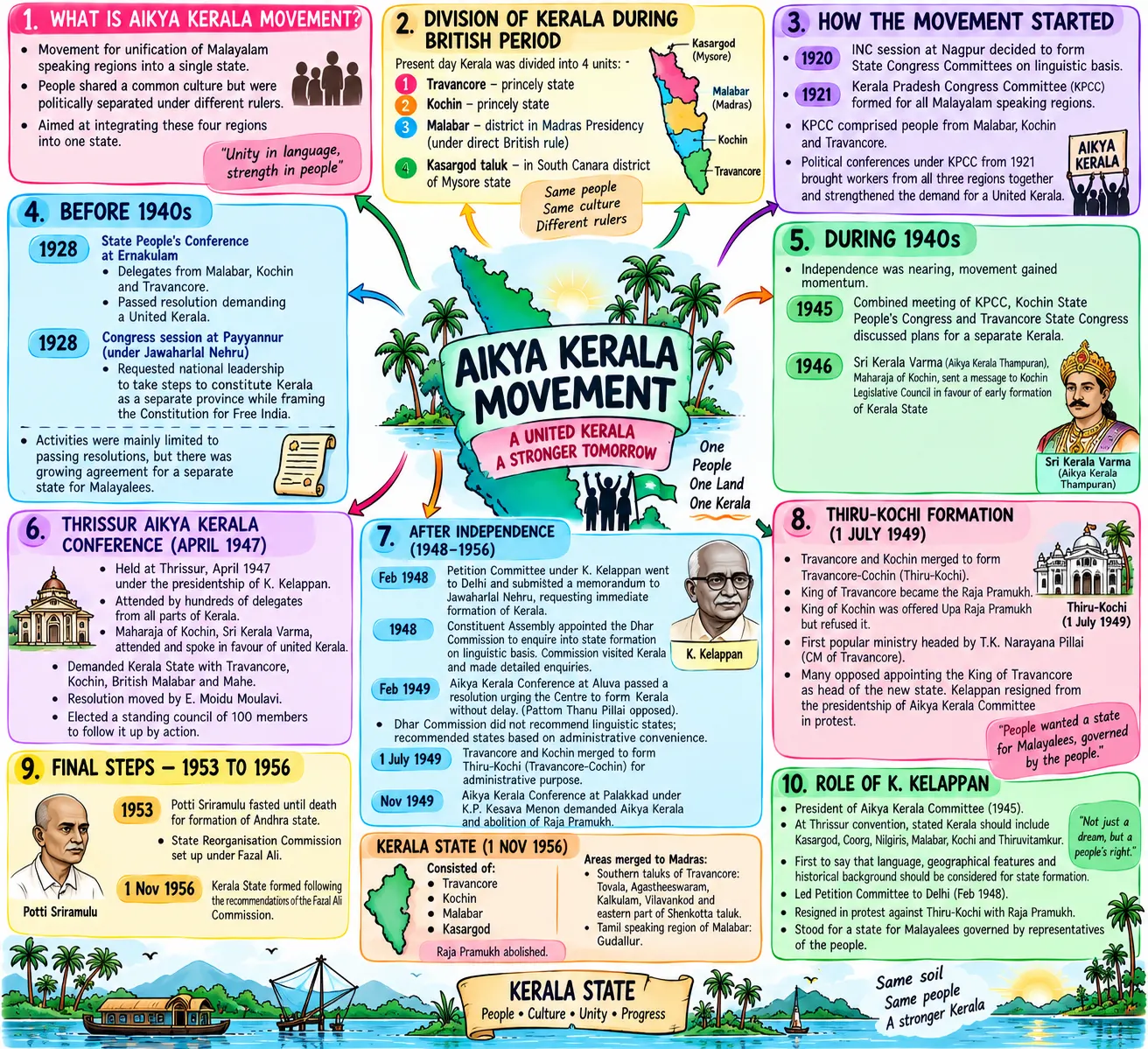
2. BEGINNING OF THE AIKYA KERALA MOVEMENT
Q3. How did the 1920 Nagpur Session of the INC contribute to the beginning of the Aikya Kerala Movement?
Answer:
- At its Nagpur Session in 1920, the Indian National Congress (INC) decided to form State Congress Committees on a linguistic basis.
- Following this decision, the Kerala Pradesh Congress Committee (KPCC) was formed in 1921.
- KPCC was created for all Malayalam-speaking regions.
- It included people from:
- Malabar
- Kochin
- Travancore
This helped develop the idea that all Malayalam-speaking people should belong to a single state.
Q4. What role did the KPCC play in developing the idea of Aikya Kerala?
Answer:
- From the formation of the KPCC in 1921, people increasingly demanded Aikya Kerala, a state for all Malayalees.
- A series of political conferences were organized under the auspices of KPCC from 1921 onwards.
- These conferences brought political workers from the three major administrative units onto a common platform:
- Malabar
- Kochin
- Travancore
- They encouraged political workers to think in terms of the formation of a United Kerala State.
3. AIKYA KERALA MOVEMENT BEFORE THE 1940s
Q5. What happened at the State People's Conference held at Ernakulam in 1928?
Answer:
- State People's Conference was held at Ernakulam in 1928.
- It was attended by delegates from:
- Malabar
- Kochin
- Travancore
- The conference passed a resolution demanding the formation of a “United Kerala.”
- The proposed state was to include all Malayalam-speaking regions.
Q6. What was the importance of the 1928 Congress Session at Payyannur?
Answer:
- A Congress Session was held at Payyannur in 1928.
- It was held under the presidentship of Jawaharlal Nehru.
- The session passed a resolution asking the national leadership of the Congress to take steps to create Kerala as a separate province.
- This was to be done when the Constitution of Free India was framed.
Q7. What was the nature of the Aikya Kerala Movement before the 1940s?
Answer:
- During this period, activities for the formation of Kerala were largely restricted to passing resolutions on different political platforms.
- However, people involved in the national movement generally accepted the idea that there should be a separate state for Malayalam-speaking people.
4. AIKYA KERALA MOVEMENT DURING THE 1940s
Q8. Why did the Aikya Kerala Movement gain momentum during the 1940s?
Answer:
- During the 1940s, people began to realize that Indian independence would soon become a reality.
- As independence approached, the movement for the formation of Aikya Kerala also gathered momentum.
- The question was no longer merely about passing resolutions; political organizations increasingly discussed concrete plans for creating the new state.
Q9. What important meeting regarding Aikya Kerala was held in 1945?
Answer:
In 1945, a combined meeting was held involving:
- Kerala Pradesh Congress Committee (KPCC)
- Kochin State People's Congress
- Travancore State Congress
The meeting discussed:
- Plans
- Programmes
to be adopted for the formation of Kerala as a separate state.
5. SRI KERALA VARMA — “AIKYA KERALA THAMPURAN”
Q10. Who was known as “Aikya Kerala Thampuran,” and how did he support the movement?
Answer:
Sri Kerala Varma, the Maharaja of Kochin, was known as:
“Aikya Kerala Thampuran.”
In 1946:
- He sent a message to the Kochin Legislative Council.
- He expressed support for the early formation of a Kerala State.
- He favoured a state comprising:
- Travancore
- Kochin
- Malabar
He later personally participated in the Aikya Kerala Conference at Thrissur in 1947 and spoke in favour of a united Kerala.
6. AIKYA KERALA CONFERENCE — THRISSUR, 1947
Q11. What were the major features of the Aikya Kerala Conference held at Thrissur in 1947?
Answer:
The Aikya Kerala Conference was held at:
- Place: Thrissur
- Date: April 1947
- President: K. Kelappan
Important features:
- Hundreds of delegates from all parts of Kerala attended.
- The reigning Maharaja of Kochin, Sri Kerala Varma, attended the conference.
- Kerala Varma spoke in favour of establishing a united Kerala comprising:
- British Malabar
- Kochin
- Travancore
Q12. What did the 1947 Thrissur Aikya Kerala Conference demand?
Answer:
The conference demanded the formation of a Kerala State consisting of:
- Princely State of Travancore
- Princely State of Kochin
- British-occupied Malayalam-speaking areas
- Mahe
The conference also:
- Passed a resolution moved by Congress leader E. Moidu Moulavi.
- The resolution demanded the early formation of Aikya Kerala.
- Elected a Standing Council of 100 members to follow up the demand through action.
7. AIKYA KERALA MOVEMENT AFTER INDEPENDENCE
Q13. What did K. Kelappan's Petition Committee do after Indian independence?
Answer:
- After independence, a Petition Committee was formed under the leadership of K. Kelappan.
- In February 1948, the committee went to Delhi.
- It submitted a memorandum to Prime Minister Jawaharlal Nehru.
- It requested the immediate formation of Kerala State.
8. DHAR COMMISSION
Q14. Why was the Dhar Commission appointed, and what did it do in Kerala?
Answer:
- The Constituent Assembly appointed a State Language Commission known as the Dhar Commission.
- Its purpose was to:
- Examine problems relating to the creation of new states on a linguistic basis.
- Submit a report to the government.
In 1948:
- The Dhar Commission visited Kerala.
- It conducted detailed enquiries into the possibility of forming a Kerala State.
Q15. What did the Dhar Commission recommend regarding linguistic states?
Answer:
The Dhar Commission:
- Did not recommend the formation of states on a linguistic basis.
- Instead, it recommended that states should be formed on the basis of administrative convenience.
9. ALUVA AIKYA KERALA CONFERENCE — 1949
Q16. Why was another Aikya Kerala Conference held at Aluva in 1949?
Answer:
- Another Aikya Kerala Conference was held at Aluva in February 1949.
- Its purpose was to persuade the authorities to hasten the process of state formation.
- It passed a resolution asking the Central Government to create the new Kerala State without delay.
However:
- Travancore State Congress leader Pattom Thanu Pillai opposed the formation of a United Kerala State.
10. FORMATION OF THIRU-KOCHI — 1949
Q17. How and when was Thiru-Kochi formed?
Answer:
- Since the Dhar Commission did not support linguistic reorganization, Travancore and Kochin were merged.
- A new state called Thiru-Kochi (Travancore-Cochin) was formed.
- Date: 1 July 1949
- It was formed for administrative purposes.
Q18. What happened to the rulers of Travancore and Kochin after the formation of Thiru-Kochi?
Answer:
- The King of Travancore became the Raja Pramukh of the new Thiru-Kochi State.
- The King of Kochin was offered the post of Upa Raja Pramukh.
- The King of Kochin refused the post.
- The source also states that the Maharaja of Kochin gave up his royal powers unconditionally for the good of the people.
Q19. Who headed the first popular ministry of Travancore-Cochin?
Answer:
- The first popular ministry of Travancore-Cochin was headed by T.K. Narayana Pillai.
- He had been the Chief Minister of Travancore.
- The ruler of Travancore became the governor of Travancore-Cochin under the title Rajpramukh.
11. OPPOSITION TO THE THIRU-KOCHI ARRANGEMENT
Q20. Why did some supporters of Aikya Kerala oppose the formation of Thiru-Kochi?
Answer:
Many people opposed:
- Appointment of the King of Travancore as head of the new state.
- Formation of a state containing only Travancore and Kochin.
They demanded a larger state comprising:
- Malabar
- Thiru-Kochi
As a protest against the Central Government's decision:
- K. Kelappan resigned from the presidentship of the Aikya Kerala Committee.
12. PALAKKAD AIKYA KERALA CONFERENCE — 1949
Q21. What happened at the Aikya Kerala Conference held at Palakkad in November 1949?
Answer:
- Another Aikya Kerala Conference was held at Palakkad in November 1949.
- President: K.P. Kesava Menon
The conference demanded:
- Formation of Aikya Kerala.
- Abolition of the post of Raja Pramukh.
13. POTTI SRIRAMULU AND STATE REORGANIZATION
Q22. How did Potti Sriramulu's agitation influence the reorganization of Indian states?
Answer:
- In 1953, Potti Sriramulu fasted until death.
- His demand was the formation of an Andhra State for Telugu-speaking people.
- Following this development, a States Reorganisation Commission was established.
- Chairman: Fazal Ali.
14. FORMATION OF KERALA — 1 NOVEMBER 1956
Q23. When and on whose recommendations was Kerala State finally formed?
Answer:
- Kerala was formed following the recommendations of the Fazal Ali Commission.
- Date of formation: 1 November 1956.
The new state consisted of:
- Travancore
- Kochin
- Malabar
- Kasargod
The post of Raja Pramukh was abolished.
Q24. Which Tamil-speaking regions of Travancore were transferred to Madras?
Answer:
The Tamil-speaking regions of Travancore were merged with Madras State.
These included the southern taluks of:
- Tovala
- Agastheeswaram
- Kalkulam
- Vilavankod
Also transferred:
- Eastern part of Shenkotta Taluk
Q25. Which Tamil-speaking region of Malabar was transferred to Madras?
Answer:
- The Tamil-speaking region of Malabar was also transferred to Madras State.
- Gudallur was merged with Madras.
15. ROLE OF K. KELAPPAN IN THE AIKYA KERALA MOVEMENT
Q26. What was K. Kelappan's overall role in the Aikya Kerala Movement?
Answer:
K. Kelappan was one of the major leaders of the Aikya Kerala Movement.
- He became President of the Aikya Kerala Committee formed in 1945.
- He presided over the Aikya Kerala Convention at Thrissur.
- He led the Petition Committee to Delhi in February 1948.
- He submitted a memorandum to Prime Minister Jawaharlal Nehru requesting the immediate formation of Kerala.
- He later resigned as President of the Aikya Kerala Committee in protest against the Thiru-Kochi arrangement under a Raja Pramukh.
Q27. What territories did K. Kelappan propose for inclusion in Kerala at the Thrissur Aikya Kerala Convention?
Answer:
At the Thrissur convention, Kelappan stated that Kerala should be formed with:
- Kasargod
- Coorg
- Nilgiris
- Malabar
- Kochi
- Thiruvitamkur (Travancore)
Q28. What principles did K. Kelappan say should be considered when creating a separate state?
Answer:
Kelappan was the first, according to the notes, to state that state formation should consider not only language, but also:
- Geographical features
- Historical background
Q29. Why did K. Kelappan resign from the presidentship of the Aikya Kerala Committee?
Answer:
- Thiru-Kochi was created with the Raja Pramukh as its head.
- Kelappan opposed this arrangement.
- He resigned from the presidentship of the Aikya Kerala Committee as a protest.
His objective was a state:
- For Malayalees
- Governed by representatives of the people
rather than headed through the old princely arrangement.
Timeline for Revision
- 1920 → Nagpur INC Session decided to organize State Congress Committees on a linguistic basis.
- 1921 → KPCC formed for Malayalam-speaking regions; political conferences began bringing Malabar, Kochin and Travancore together.
- 1928 → State People's Conference, Ernakulam demanded United Kerala.
- 1928 → Payyannur Congress Session, presided over by Jawaharlal Nehru, demanded a separate Kerala province.
- 1945 → Combined meeting of KPCC, Kochin State People's Congress and Travancore State Congress; Aikya Kerala Committee under K. Kelappan.
- 1946 → Kochin Maharaja Sri Kerala Varma, “Aikya Kerala Thampuran,” supported Kerala State.
- April 1947 → Aikya Kerala Conference, Thrissur, presided over by K. Kelappan; E. Moidu Moulavi moved the resolution; 100-member Standing Council elected.
- February 1948 → Kelappan-led Petition Committee went to Delhi and submitted a memorandum to Jawaharlal Nehru.
- 1948 → Dhar Commission visited Kerala.
- February 1949 → Aluva Aikya Kerala Conference demanded immediate state formation; Pattom Thanu Pillai opposed United Kerala.
- 1 July 1949 → Thiru-Kochi formed by merging Travancore and Kochin.
- November 1949 → Palakkad Aikya Kerala Conference, presided over by K.P. Kesava Menon, demanded Aikya Kerala and abolition of Raja Pramukh.
- 1953 → Potti Sriramulu's fast until death for Andhra; States Reorganisation Commission established under Fazal Ali.
- 1 November 1956 → Kerala State formed with Travancore, Kochin, Malabar and Kasargod; Raja Pramukh abolished; specified Tamil-speaking areas transferred to Madras.