National Movement in Kerala | PSC Notes
1. POLITICAL MOVEMENTS IN MALABAR
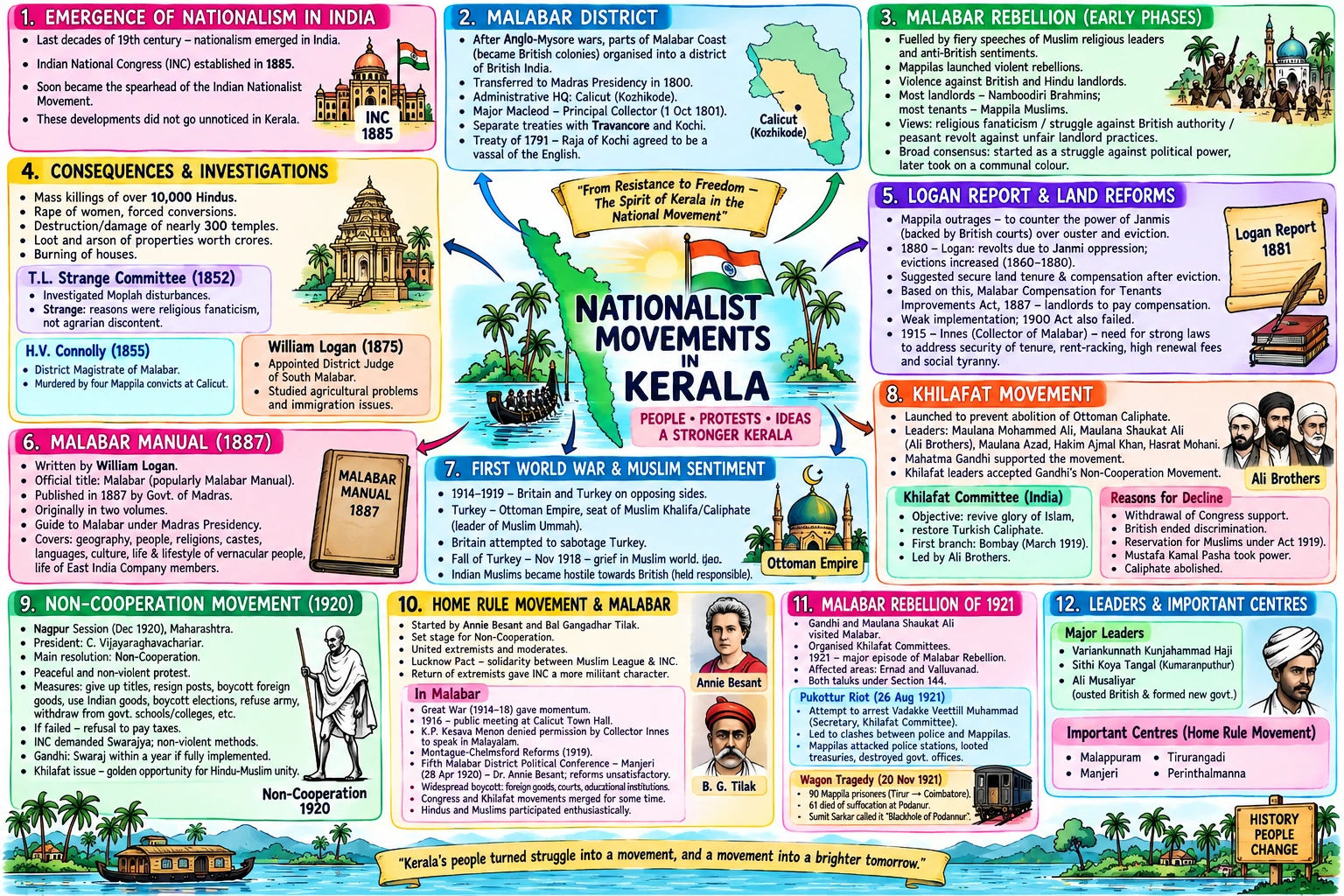
Emergence of Nationalism
Q1. When did nationalism emerge in India, and how was Kerala connected with it?
Answer:
- The last decades of the 19th century saw the emergence of nationalism in India.
- The Indian National Congress (INC) was established in 1885.
- It soon became the spearhead of the Indian Nationalist Movement.
- These developments also influenced Kerala.
2. MALABAR DISTRICT
Q2. How did Malabar come under British administration?
Answer:
- After the Anglo-Mysore Wars, parts of the Malabar Coast that became British colonies were organized into a district of British India.
- In 1800, Malabar was transferred to the Madras Presidency.
- Administrative headquarters: Calicut (Kozhikode).
- Major Macleod became the Principal Collector on 1 October 1801.
- The East India Company entered into separate fresh treaties with Travancore and Kochi.
- Under the Treaty of 1791, the Raja of Kochi agreed to become a vassal of the English.
3. MALABAR REBELLION — EARLY BACKGROUND
Q3. What factors led to the early Mappila rebellions in Malabar?
Answer:
According to the notes:
- The rebellions were fuelled by:
- Fiery speeches of Muslim religious leaders
- Anti-British sentiments
- The Mappilas launched violent rebellions.
- Violence was directed against:
- British authorities
- Hindu landlords
- Most landlords were Namboodiri Brahmins.
- Most tenants were Mappila Muslims.
The nature of the rebellion has been interpreted differently:
- Some viewed it as religious fanaticism.
- Others regarded it as a struggle against British authority.
- Another interpretation sees it as a peasant revolt against unfair landlord practices.
- The notes state that a broad consensus sees it as beginning as a struggle against political power and later acquiring a communal colour.
Q4. What consequences of the Malabar riots are mentioned in the notes?
Answer:
The source states that the riots resulted in:
- Mass killings of over 10,000 Hindus
- Rape of women
- Forced religious conversions
- Destruction or damage of nearly 300 temples
- Loot and arson of property worth crores of rupees
- Burning of Hindu houses
These figures and characterizations are presented here as given in the source notes.
Q5. What was the T.L. Strange Committee, and what did Strange conclude?
Answer:
- T.L. Strange Committee was a special committee appointed to investigate the Moplah disturbances in Malabar.
- Year: 1852
- Strange concluded that the outbreaks were caused by religious fanaticism rather than agrarian discontent.
Q6. What happened to H.V. Connolly, and what role did William Logan later play in Malabar?
Answer:
H.V. Connolly:
- District Magistrate of Malabar.
- Murdered in 1855.
- Four Mappila convicts killed him at his bungalow in Calicut.
William Logan:
- Appointed District Judge of South Malabar in 1875.
- Studied:
- Agricultural problems of the Mappila taluks
- Immigration problems created by colonial rule.
4. LOGAN REPORT — 1881
Q7. What did William Logan conclude about the causes of Mappila revolts?
Answer:
The Logan Report – 1881 gave importance to agrarian causes.
Logan described the Mappila outrages as an attempt to counter the growing power of the Janmis, backed by British courts, particularly their new powers of:
- Ouster
- Eviction for rent
In a second investigation in 1880, Logan concluded:
- Revolts were caused by Janmi oppression of tenants.
- Evictions increased enormously between 1860 and 1880.
He recommended laws to:
- Secure land tenure
- Provide compensation after eviction.
Q8. What legislation followed the Logan Report, and why did it fail to solve the peasants' problems?
Answer:
The British government introduced land-reform legislation in Malabar.
Malabar Compensation for Tenants Improvements Act, 1887
- Required landlords to compensate tenants for improvements they had made to the land.
However:
- The Act was weakly implemented.
- Its successor, the 1900 Act, also failed to substantially improve peasant conditions.
In 1915, Innes, Collector of Malabar, argued that stronger legislation was necessary to deal with:
- Security of tenure
- Rent-racking
- High renewal fees
- Social tyranny
The British government did not act on these concerns.
5. MALABAR MANUAL
Q9. What is the Malabar Manual, and who wrote it?
Answer:
- Written by William Logan.
- Official title: Malabar
- Popularly known as the Malabar Manual.
- Published in 1887.
- Commissioned by the Government of Madras.
- Originally published in two volumes.
- Compiled during Logan's tenure as Collector of Malabar.
- It served as a guide to the Malabar District under the Madras Presidency.
It provides extensive information about:
- Geography
- People
- Religions
- Castes
- Languages
- Culture
- Life and lifestyle of the vernacular people of Malabar
- Life of members of the East India Company.
6. FIRST WORLD WAR AND THE CALIPHATE
Q10. How did the First World War affect Muslim political sentiment in India?
Answer:
First World War: 1914–1919
- Britain and Turkey were on opposing sides.
- Turkey was home to the Ottoman Empire.
- It was the seat of the Muslim Khalifa or Caliphate.
- The Khalifa/Caliph was regarded as:
- Leader of the Muslim Ummah
- Political leader
- Religious leader of Muslims throughout the world
- The Ottoman Empire's ability to resist Europe was a matter of pride.
The notes state:
- Britain attempted to sabotage Turkey's Ottoman Empire.
- The fall of Turkey in November 1918 caused grief across the Muslim world.
- Indian Muslims became hostile towards the British because Britain was held responsible for Turkey's misfortune.
7. KHILAFAT MOVEMENT
Q11. Why was the Khilafat Movement launched, and who led it?
Answer:
During the First World War:
- Turkey was one of the Central Powers.
- It fought against Britain.
- After Turkey's defeat, dissolution of the Ottoman Caliphate was proposed.
- Muslims regarded the Sultan of Turkey as their Caliph, or religious head.
The Khilafat Movement was led by:
- Maulana Mohammed Ali
- Maulana Shaukat Ali
- Together known as the Ali Brothers
- Maulana Azad
- Hakim Ajmal Khan
- Hasrat Mohani
Mahatma Gandhi supported the movement in its effort to persuade Britain not to abolish the Caliphate.
The Khilafat leaders accepted Gandhi's Non-Cooperation Movement, creating a joint protest against British rule.
Q12. What was the Khilafat Committee in India?
Answer:
Its objective was to:
- Revive and restore the “glory of Islam”
- Restore the Turkish Caliphate
In India:
- First branch: Bombay
- Date: March 1919
- Led by the Ali Brothers:
- Maulana Mohammed Ali
- Maulana Shaukat Ali.
Q13. Why did the Khilafat Movement decline?
Answer:
The notes list the following factors:
- Withdrawal of support by the Congress
- British abandonment of the policy of discrimination against Muslims
- Reservation of seats for Muslims in Central and Provincial Legislatures under the Act of 1919
- Mustafa Kamal Pasha assumed power in Turkey.
- The Caliphate was abolished.
8. NON-COOPERATION MOVEMENT
Q14. What happened at the Nagpur Session of the INC in December 1920?
Answer:
- The annual INC session was held at Nagpur, Maharashtra, in December 1920.
- President: C. Vijayaraghavachariar
- The INC passed its main resolution on Non-Cooperation at this session.
The Gandhi-Ali Brothers partnership contributed to Hindu-Muslim unity through the combined Khilafat–Non-Cooperation Movement against British rule.
Q15. What were the major features of the Non-Cooperation Movement?
Answer:
The movement was intended to be a peaceful and non-violent protest against British rule.
People were asked to:
- Give up titles.
- Resign from nominated seats in local bodies.
- Resign from government jobs.
- Withdraw children from government-controlled or government-aided schools and colleges.
- Boycott foreign goods.
- Use Indian-made goods.
- Boycott elections to legislative councils.
- Refuse to serve in the British army.
If these measures failed:
- Refusal to pay taxes was also planned.
Other key points:
- INC demanded Swarajya or self-government.
- Only completely non-violent methods were to be used.
- It marked an important change because the INC was prepared to move beyond constitutional methods to obtain self-rule.
- Gandhi said Swaraj could be achieved within a year if the movement was carried through to completion.
- Gandhi considered the Khilafat issue a golden opportunity for Hindu-Muslim unity and urged Hindus to support it.
9. HOME RULE MOVEMENT AND MALABAR
Q16. Who started the Home Rule Movement, and what was its wider significance?
Answer:
The Home Rule Movement was started by:
- Annie Besant
- Bal Gangadhar Tilak
Its significance:
- Set the stage for the Non-Cooperation Movement.
- United the extremists and moderates of the INC.
- The Lucknow Pact brought solidarity between the Muslim League and Congress.
- Return of the extremists gave the INC a more militant character.
Q17. How did the Home Rule and nationalist movements develop in Malabar during and after the First World War?
Answer:
- The Great War (1914–1918) gave momentum to the nationalist movement in Malabar.
- In 1916, a public meeting was held at Calicut Town Hall to mobilize support for the government's war efforts.
- K.P. Kesava Menon was denied permission by Collector Innes to address the meeting in Malayalam.
- After the war came the Montague-Chelmsford Reforms of 1919.
Fifth Malabar District Political Conference:
- Venue: Manjeri
- Date: 28 April 1920
- Dr. Annie Besant was present.
- It passed a resolution describing the reforms as unsatisfactory and disappointing.
Malabar also witnessed widespread boycott of:
- Foreign goods
- Courts of law
- Educational institutions
Meanwhile:
- Khilafat agitation developed against British policy.
- For some time, the Congress and Khilafat movements merged into one movement.
- Hindus and Muslims participated enthusiastically.
10. MALABAR REBELLION OF 1921
Q18. How did the Khilafat and nationalist movements contribute to developments in Malabar before the 1921 rebellion?
Answer:
- Mahatma Gandhi and Maulana Shaukat Ali visited Malabar.
- They organized Khilafat Committees.
- They also sought to accelerate the nationalist struggle against foreign rule.
- 1921 saw the most important episode of the Malabar Rebellion.
- Most affected areas:
- Ernad
- Valluvanad
- Both taluks were placed under Section 144.
Q19. What was the Pukottur Riot?
Answer:
- Place: Pukottur, Ernad taluk
- Date given: 26 August 1921
- Authorities attempted to arrest Vadakke Veettil Muhammad.
- He was secretary of the local Khilafat Committee at Pukottur.
- The attempted arrest led to violent clashes between:
- Police
- Mappilas
During the rebellion, Mappilas:
- Attacked police stations
- Looted government treasuries
- Destroyed government offices.
Q20. Who were the major leaders and important centres associated with this phase of the movement?
Answer:
Major leaders listed in the notes:
- Variankunnath Kunjahammad Haji
- Sithi Koya Tangal of Kumaranputhur
- Ali Musaliyar
The notes list these as major centres of the Home Rule Movement in Kerala:
- Malappuram
- Tirurangadi
- Manjeri
- Perinthalmanna
The notes also state:
- Ali Musaliyar ousted the British Government and formed a new government.
Q21. What was the Wagon Tragedy?
Answer:
- Date: 20 November 1921
- 90 Mappila prisoners were transported in a closed railway goods wagon.
- Route: Tirur → Coimbatore
- By the time the train reached Podanur, 61 of the 90 prisoners had died of suffocation.
Historian Sumit Sarkar described the incident as:
“Blackhole of Podannur.”
He drew a parallel with the alleged Black Hole tragedy of 1756, which the notes state most recent studies say did not occur as traditionally described in history books.
11. BEGINNINGS OF THE NATIONAL MOVEMENT — CONGRESS SESSIONS
Q22. Who was the first Malayali President of the Indian National Congress?
Answer:
- Chettoor Sankaran Nair
- Became the first Malayali President of the INC.
- Session: Amaravati INC Session
- Year: 1897.
Q23. What are the important early Congress and Home Rule milestones in Malabar?
Answer:
- 1897 – Amaravati INC Session: Chettoor Sankaran Nair became first Malayali INC President.
- 1908 – Malabar District Congress Committees: K.P. Kesava Menon.
- 1916: Branch of the All-India Home Rule League, founded by Dr. Annie Besant, began functioning in the district.
- Palakkad – 1916: Annie Besant.
- Calicut – 1917: C.P. Ramaswami Iyer.
- Thalasseri – 1918: Azad Ali Khan.
- Vadakara – 1919: K.P. Raman Menon.
- Manjeri – 1920: Kasthuri Ranga Aiyankar.
- Nagpur INC Session – 1920: Non-Cooperation Movement; Congress committees reorganized on a linguistic basis.
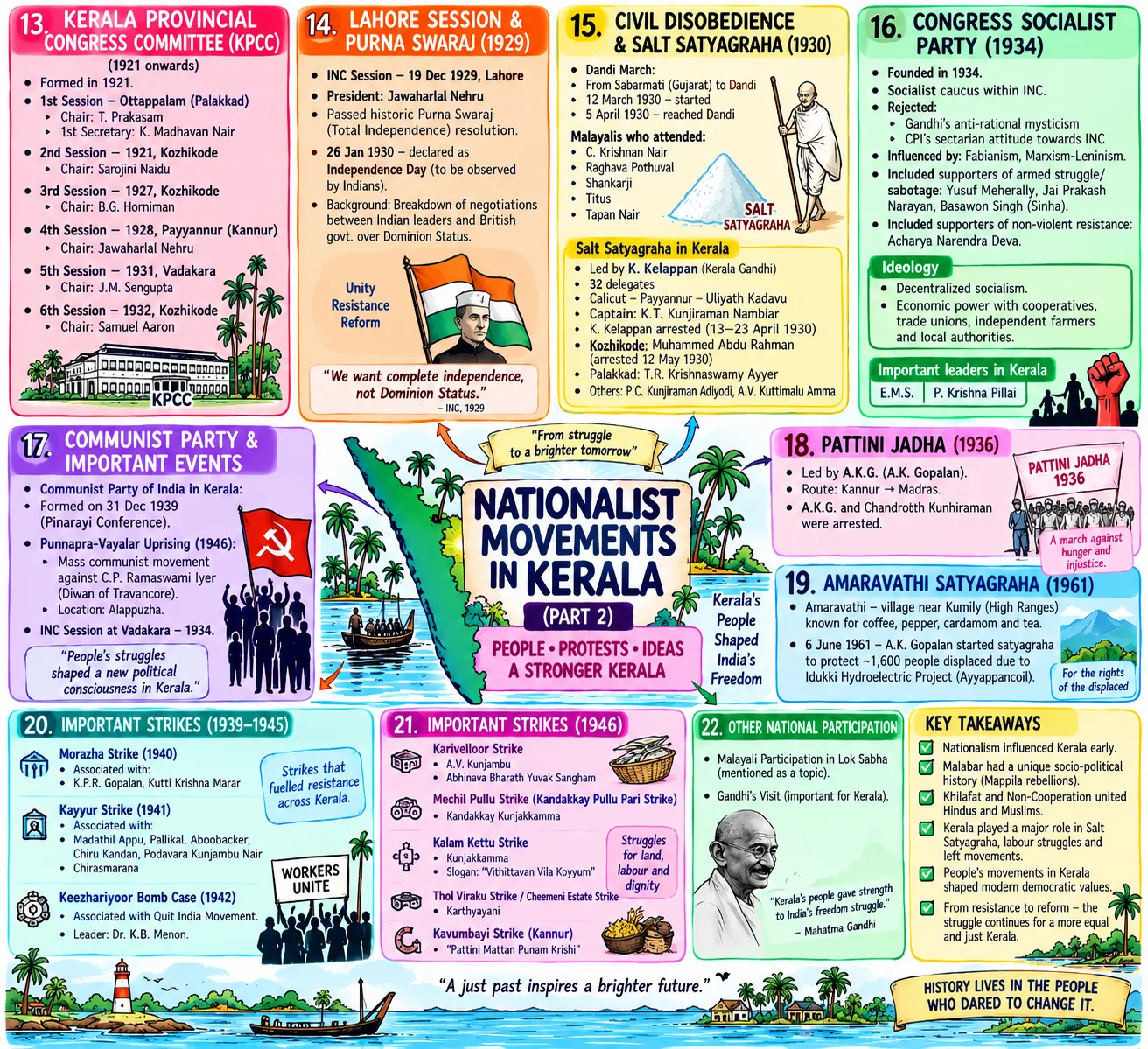
12. KERALA PROVINCIAL CONGRESS COMMITTEE — 1921
Q24. When was the KPCC formed, and what were its first important sessions?
Answer:
Kerala Provincial Congress Committee (KPCC): 1921
First Session
- Place: Ottappalam, Palakkad
- Chaired by: T. Prakasam
- First KPCC Secretary: K. Madhavan Nair
Second Session
- Year: 1921
- Place: Kozhikode
- Chaired by: Sarojini Naidu
Third Session
- Year: 1927
- Place: Kozhikode
- Chaired by: B.G. Horniman
Fourth Session
- Year: 1928
- Place: Payyannur, Kannur
- Chaired by: Pandit Jawaharlal Nehru
Fifth Session
- Year: 1931
- Place: Vadakara
- Chaired by: J.M. Sengupta
Sixth Session
- Year: 1932
- Place: Kozhikode
- Chaired by: Samuel Aaron.
13. LAHORE SESSION AND PURNA SWARAJ
Q25. What happened at the Lahore Session of the INC in 1929?
Answer:
- Date: 19 December 1929
- Venue: Lahore
- President: Jawaharlal Nehru
- INC passed the historic Purna Swaraj or Total Independence Resolution.
A public declaration was made on:
26 January 1930
- Congress urged Indians to observe the day as Independence Day.
The resolution followed the breakdown of negotiations between:
- Indian freedom movement leaders
- British government
The dispute concerned Dominion Status for India.
Q26. What additional facts about Kerala Provincial Conferences are given in the sample-question section?
Answer:
The source's questions themselves provide these exam-relevant statements:
Second Kerala Provincial Conference, Palghat – 1923
The listed resolutions concern:
- Equal participation of Indians in administration
- Harmonious relations between Hindus and Muslims
- Ending exorbitant export duties
Fifth Malabar District Political Conference
- Date: 28 April 1920
- Venue: Manjeri
- Witnessed a split between moderate and extremist elements.
Fourth Provincial Conference of KPCC
The statements given in the source associate it with:
- Anticipating the Purna Swaraj resolution
- Demand for a separate Kerala province
- Payyannur as its venue
The sample question asks which combination is correct rather than directly supplying an answer key.
14. CIVIL DISOBEDIENCE MOVEMENT AND SALT SATYAGRAHA — 1930
Q27. What are the important facts about Gandhi's Dandi March and Malayali participation?
Answer:
Civil Disobedience Movement: 1930
Salt Satyagraha / Dandi March
- From: Sabarmati, Gujarat
- To: Dandi
- Started: 12 March 1930
- Reached Dandi: 5 April 1930
The notes list five Malayalis who attended the Salt Satyagraha:
- C. Krishnan Nair
- Raghava Pothuval
- Shankarji
- Titus
- Tapan Nair.
Q28. Who led the Salt Satyagraha in Kerala, and what were its important centres and leaders?
Answer:
K. Kelappan, known as Kerala Gandhi, led the Salt Satyagraha in Kerala.
- The march had 32 delegates.
Important places and leaders listed:
Calicut – Payyannur – Uliyath Kadavu
- Captain: K.T. Kunjiraman Nambiar
- K. Kelappan was arrested during 13–23 April 1930.
Kozhikode
- Muhammed Abdu Rahman
- Arrested on 12 May 1930.
Palakkad
- T.R. Krishnaswamy Ayyer
Other personalities:
- P.C. Kunjiraman Adiyodi
- A.V. Kuttimalu Amma.
15. CONGRESS SOCIALIST PARTY — 1934
Q29. What was the Congress Socialist Party, and what ideology did it follow?
Answer:
- Congress Socialist Party (CSP) was founded in 1934.
- It functioned as a socialist caucus within the Indian National Congress.
According to the notes, its founders rejected:
- What they considered Gandhi's anti-rational mysticism
- The Communist Party of India's sectarian attitude towards Congress
It was influenced by:
- Fabianism
- Marxism-Leninism
It included supporters of armed struggle or sabotage such as:
- Yusuf Meherally
- Jai Prakash Narayan
- Basawon Singh (Sinha)
It also included supporters of Ahimsa/non-violent resistance, such as:
- Acharya Narendra Deva.
Q30. What economic system did the CSP advocate, and who were its important Kerala leaders?
Answer:
CSP advocated decentralized socialism.
A substantial share of economic power was to be held by:
- Cooperatives
- Trade unions
- Independent farmers
- Local authorities
Important CSP leaders in Kerala:
- E.M.S.
- P. Krishna Pillai.
16. COMMUNIST PARTY AND OTHER IMPORTANT EVENTS
Q31. When was the Communist Party of India formed in Kerala, and what was the Punnapra-Vayalar uprising?
Answer:
Communist Party of India in Kerala
- Formed: 31 December 1939
- Associated with the Pinarayi Conference.
Punnapra-Vayalar Uprising
- Year: 1946
- Described in the notes as a mass communist movement.
- Directed against C.P. Ramaswami Iyer, the Diwan of Travancore.
- Location: Alappuzha.
Other event:
- INC Session at Vadakara – 1934.
Q32. What was the Pattini Jadha?
Answer:
- Year: 1936
- Led by A.K.G.
- Route: Kannur → Madras
- A.K.G. and Chandroth Kunhiraman were arrested.
17. AMARAVATHI SATYAGRAHA — 1961
Q33. What was the Amaravathi Satyagraha, and why did A.K. Gopalan lead it?
Answer:
Amaravathi is a village near Kumily in the High Ranges, associated with cultivation of:
- Coffee
- Pepper
- Cardamom
- Tea
On 6 June 1961:
- Communist veteran A.K. Gopalan (AKG) began a satyagraha at Amaravathi.
- Its purpose was to protect around 1,600 people who had been displaced.
- Their land had been acquired for the Idukki Hydroelectric Project at Ayyappancoil.
- They had been removed from their land and left at Amaravathi.
18. IMPORTANT STRIKES — 1939–1945
Q34. What were the important strikes and revolutionary incidents between 1939 and 1945?
Answer:
Morazha Strike – 1940
Associated with:
- K.P.R. Gopalan
- Kutti Krishna Marar
Kayyur Strike – 1941
Associated with:
- Madathil Appu
- Pallikal Aboobacker
- Chiru Kandan
- Podavara Kunjambu Nair
- The notes also mention “Chirasmarana.”
Keezhariyoor Bomb Case – 1942
- Associated with the Quit India Movement.
- Associated leader: Dr. K.B. Menon.
19. IMPORTANT STRIKES OF 1946
Q35. What were the major strikes of 1946 and the personalities associated with them?
Answer:
Karivelloor Strike
- A.V. Kunjambu
- Abhinava Bharath Yuvak Sangham
Mechil Pullu Strike
- Also given as Kandakkay Pullu Pari Strike
- Associated with Kandakkay Kunjakkamma
Kalam Kettu Strike
- Associated with Kunjakkamma
- Slogan/phrase given: “Vithittavan Vila Koyyum”
Tholviraku Strike / Cheemeni Estate Strike
- Associated with Karthyayani
Kavumbayi Strike
- Place: Kannur
- Associated phrase: “Pattini Mattan Punam Krishi”.
Timeline for Revision
- 1791 – Treaty involving Kochi and the English
- 1800 – Malabar transferred to Madras Presidency
- 1 Oct 1801 – Major Macleod became Principal Collector
- 1852 – T.L. Strange Committee
- 1855 – H.V. Connolly murdered
- 1875 – William Logan appointed District Judge of South Malabar
- 1880 – Logan's second investigation
- 1881 – Logan Report
- 1885 – Indian National Congress established
- 1887 – Malabar Manual; Malabar Compensation for Tenants Improvements Act
- 1897 – Chettoor Sankaran Nair, Amaravati INC Session
- 1908 – Malabar District Congress Committees
- 1914–1918/19 – First World War period
- 1916 – Home Rule activity in Malabar; Palakkad
- 1917 – Calicut
- 1918 – Thalasseri; fall of Turkey mentioned as November 1918
- 1919 – Khilafat Committee in Bombay; Vadakara; Montague-Chelmsford Reforms
- 28 Apr 1920 – Fifth Malabar District Political Conference, Manjeri
- Dec 1920 – Nagpur INC Session; Non-Cooperation resolution
- 1921 – KPCC; major Malabar Rebellion
- 26 Aug 1921 – Pukottur Riot date given in notes
- 20 Nov 1921 – Wagon Tragedy
- 1923 – Second Kerala Provincial Conference at Palghat, as given in sample questions
- 1927 – Third KPCC session
- 1928 – Fourth KPCC session, Payyannur
- 19 Dec 1929 – Purna Swaraj resolution
- 26 Jan 1930 – Independence Day declaration
- 12 Mar–5 Apr 1930 – Dandi March
- 1931 – Fifth KPCC session
- 1932 – Sixth KPCC session
- 1934 – Congress Socialist Party; INC session at Vadakara
- 1936 – Pattini Jadha
- 31 Dec 1939 – Communist Party in Kerala/Pinarayi Conference
- 1940 – Morazha Strike
- 1941 – Kayyur Strike
- 1942 – Keezhariyoor Bomb Case
- 1946 – Punnapra-Vayalar and important labour/peasant strikes
- 6 June 1961 – Amaravathi Satyagraha