History
/ Kerala History
Dutch in Kerala - Arrival of Europeans in Kerala | PSC Notes
1. Who were the Dutch and what was their objective in Kerala?
Answer:
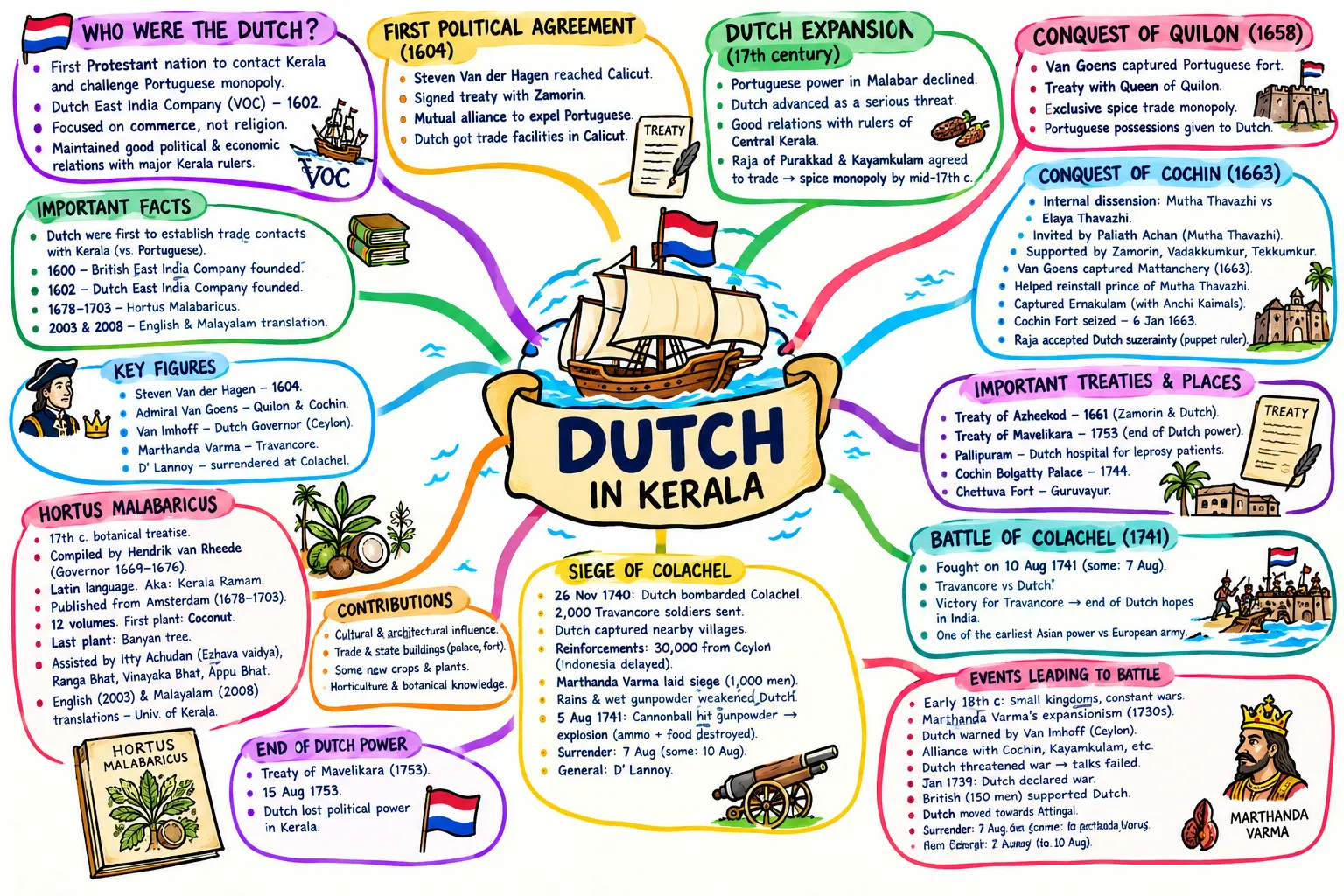
- The Dutch were the first Protestant nation of Europe to establish trade contacts with Kerala.
- They challenged the Portuguese monopoly over trade.
- The Dutch East India Company (VOC) was established in 1602.
- Their trade relations with Kerala rulers posed a major challenge to Portuguese commercial monopoly.
- Unlike the Portuguese, the Dutch focused mainly on the expansion of commerce and largely kept religious policy aside.
- They maintained good political and economic relations with the major rulers of Kerala.
2. What was the first political agreement between the Dutch and the Zamorin?
Answer:
- In 1604, Dutch Admiral Steven Van der Hagen reached Calicut.
- He signed the first political agreement between the Dutch and the Zamorin.
- The agreement provided for a mutual alliance between the Dutch and the Zamorin.
- Their common objective was to expel the Portuguese from the region.
- The treaty also allowed the Dutch to establish trade facilities at Calicut.
3. How did Dutch power develop in Kerala during the early 17th century?
Answer:
- During the early decades of the 17th century, Portuguese power in Malabar was deteriorating.
- At the same time, Dutch power was expanding.
- The Dutch became a serious threat to Portuguese stability in Malabar.
- The Dutch established friendly political and commercial relations with rulers of Central Kerala.
- The Raja of Purakkad and the Raja of Kayamkulam agreed to conduct trade with the Dutch.
- These arrangements helped the Dutch secure a monopoly over the spice trade by the middle of the 17th century.
CONQUEST OF QUILON
4. When and how did the Dutch conquer Quilon?
Answer:
- After eliminating Portuguese power from Ceylon, the Dutch began their political conquest of Quilon in 1658.
- Dutch Admiral Van Goens captured the Portuguese fortress of Quilon.
- He then signed a treaty with the Queen of Quilon.
- The treaty gave the Dutch an exclusive monopoly over the spice trade.
- Portuguese possessions were transferred to the Dutch.
CONQUEST OF COCHIN
5. Why is the conquest of Cochin important in Dutch history in Kerala?
Answer:
- The real history of the Dutch in Kerala is considered to have begun with the conquest of Cochin in 1663.
- The political situation in Cochin was marked by internal dissension between:
- Mutha Thavazhi
- Elaya Thavazhi
- The Dutch were invited by Paliath Achan on behalf of the Mutha Thavazhi.
- The Dutch were supported by:
- Zamorin
- Raja of Vadakkumkur
- Raja of Tekkumkur
6. How did the Dutch capture Cochin in 1663?
Answer:
- In 1663, the Dutch force under Van Goens marched against the Mattanchery Palace.
- The battle resulted in severe casualties.
- The Dutch helped reinstall the prince of the Mutha Thavazhi as the ruler of Cochin.
- However, the Portuguese challenge still remained.
- Portuguese resistance continued.
- The Dutch captured Portuguese strongholds in Ernakulam with the help of the Anchi Kaimals.
- With the assistance of Vira Kerala Varma and his Prime Minister Paliath Achan, the Dutch captured Cochin Fort on 6 January 1663.
- The Raja of Cochin accepted Dutch suzerainty.
- The treaty effectively made the Raja of Cochin a puppet in the hands of the Dutch.
IMPORTANT DUTCH TREATIES AND BUILDINGS
7. What was the Treaty of Azheekod?
Answer:
- The Treaty of Azheekod was concluded between the Zamorin and the Dutch in 1661.
8. What are the important places and buildings associated with Dutch rule in Kerala?
Answer:
- Pallipuram was the place where the Dutch constructed a hospital for leprosy patients.
- The Cochin Bolgatty Palace was constructed by the Dutch in 1744.
- The Dutch constructed Chettuva Fort near Guruvayur.
BATTLE OF COLACHEL
9. What was the Battle of Colachel and when was it fought?
Answer:
- The Battle of Colachel (Kulachal) was fought between:
- Kingdom of Travancore
- Dutch East India Company
- It took place in August 1741.
- The key date given in the notes is 10 August 1741.
- The battle resulted in a famous victory for Travancore.
- It effectively ended Dutch colonial ambitions in the Indian subcontinent.
- It is considered one of the earliest instances of an organised Asian power defeating a European army.
EVENTS LEADING TO THE BATTLE OF COLACHEL
10. What was the political situation in Kerala before the Battle of Colachel?
Answer:
- In the early 18th century, Kerala consisted of several small kingdoms.
- These kingdoms were frequently engaged in warfare with one another.
- In the 1730s, Marthanda Varma, the new ruler of Travancore, adopted an expansionist policy.
- He conquered several small kingdoms of Malabar.
- These conquests threatened the economic interests of the Dutch East India Company.
11. How did the Dutch respond to the expansion of Marthanda Varma?
Answer:
- Gustaaf Willem van Imhoff, the Dutch Governor of Ceylon (Sri Lanka), visited Kochi.
- He recommended military action to protect Dutch trade in Malabar.
- The Dutch formed a military alliance with Travancore's neighbouring powers, including:
- Quilon
- Cochi
- Kayamkulam
- Van Imhoff initially used diplomacy to avoid war.
- He personally met Marthanda Varma to negotiate peace.
12. What happened during the negotiations between Van Imhoff and Marthanda Varma?
Answer:
- During the subsequent meeting, Van Imhoff threatened war if Travancore did not accept the Dutch terms.
- Marthanda Varma reportedly laughed off the threat.
- He stated that even if the Dutch defeated him, he would one day invade the Netherlands and Europe itself with fishing boats.
- The negotiations eventually broke down.
- War became inevitable.
13. How did the Dutch war against Travancore begin?
Answer:
- In late 1739, the Dutch army in Malabar declared war on Travancore.
- Dutch troops from Ceylon were deployed.
- The Dutch and their allies initially achieved several victories.
- They forced the Travancore army at Kollam to retreat.
- The British East India Company, concerned about the growing power of Travancore, supported the Dutch.
- The British East India Company had been founded on 31 December 1600.
- The British sent 150 men to supplement the Dutch forces.
- The combined Dutch army then marched towards Attingal.
- They took advantage of the Travancore withdrawal caused by an invasion by Arcot from the south.
SIEGE OF COLACHEL
14. How did the Siege of Colachel begin?
Answer:
- On 26 November 1740, the Dutch sent a naval force to Colachel.
- The Dutch bombarded the town.
- The bombardment forced the inhabitants to abandon the town.
- Marthanda Varma responded by sending a force of 2,000 soldiers to Colachel.
- The Dutch planned to occupy Colachel as a step towards capturing Padmanabhapuram, the capital of Travancore.
- After capturing Colachel, the Dutch began occupying nearby villages.
- They plundered the region between Colachel and Kottar.
15. What reinforcements did the Dutch seek during the Siege of Colachel?
Answer:
- The Dutch requested reinforcements from:
- Sri Lanka
- Indonesia
- The authorities in Indonesia were occupied with a native rebellion and could not provide the expected support.
- However, about 30,000 additional men from Ceylon arrived as reinforcements, according to the notes.
16. How did Marthanda Varma turn the situation against the Dutch?
Answer:
- Marthanda Varma took advantage of the shortage of Dutch troops.
- He launched an offensive to recapture Colachel.
- He used patrol boats to block Dutch supplies coming by sea.
- He laid siege to Colachel.
- The Dutch were surrounded by a 1,000-strong Travancore army.
- Although the Dutch had technological superiority and were able to inflict casualties on the Travancore forces, they faced serious difficulties.
- Rains and floods prevented the Dutch from receiving supplies.
- Much of their gunpowder became wet, preventing them from offering effective resistance.
17. What happened on 5 August 1741 during the Battle of Colachel?
Answer:
- On 5 August 1741, a cannonball fired by the Travancore army hit a barrel of gunpowder inside the Dutch garrison.
- The explosion destroyed the:
- Ammunition store
- Food stores
- The Dutch were left without sufficient ammunition and food.
- They were therefore forced to surrender on 7 August 1741.
- Some historians consider 10 August 1741 as the official date of surrender.
18. Who was the Dutch general who surrendered at Colachel?
Answer:
- D' Lannoy was the Dutch general who surrendered to Marthanda Varma.
- He later became an important military figure in Travancore.
- His burial is associated with Udayagiri Fort near Thakkala, Tamil Nadu.
19. What was the significance of the Battle of Colachel?
Answer:
- The victory established the military strength of Travancore.
- It effectively ended Dutch colonial ambitions in the Indian subcontinent.
- It is remembered as one of the earliest major victories of an Asian power over a European army.
- The defeat seriously weakened Dutch political ambitions in Kerala.
END OF DUTCH POLITICAL POWER
20. What marked the decline of Dutch political power in Kerala?
Answer:
- The Treaty of Mavelikara marked the eclipse of the Dutch as a major political power in Kerala.
- The treaty was concluded in 1753.
- The date given in the notes is 15 August 1753.
- After this, Dutch political influence in Kerala declined sharply.
HORTUS MALABARICUS
21. What is Hortus Malabaricus?
Answer:
- Hortus Malabaricus is a 17th-century botanical treatise dealing with the medicinal properties of the flora of the Malabar Coast.
- It was compiled by Hendrik van Rheede.
- Van Rheede was the Governor of Dutch Malabar from 1669 to 1676.
- It was compiled in the Latin language.
- It is also known as Kerala Ramam.
- It was published from Amsterdam.
- It was published between 1678 and 1703.
- It consists of 12 volumes.
22. Who was Itty Achudan and what was his role in Hortus Malabaricus?
Answer:
- Itty Achudan was a distinguished herbalist.
- He belonged to the ancient traditional Ezhava physician tradition of Kerala.
- He was the key informant of Van Rheede.
- He disclosed traditional Ayurvedic knowledge about the plants of Malabar to Van Rheede.
- The physicians and scholars who assisted in the work included:
- Itty Achudan
- Ranga Bhat
- Vinayaka Bhat
- Appu Bhat
23. What are the important plant-related facts about Hortus Malabaricus?
Answer:
- The first plant mentioned in Hortus Malabaricus is the coconut.
- The last plant mentioned is the banyan tree.
24. Who else assisted Van Rheede in compiling Hortus Malabaricus?
Answer:
- Van Rheede was assisted by the King of Cochin.
- He was also assisted by the Zamorin of Calicut.
- Important contributors included:
- Itty Achudan
- Ranga Bhat
- Vinayaka Bhat
- Appu Bhat
25. When and where were English and Malayalam translations of Hortus Malabaricus published?
Answer:
- The English translation was published by the University of Kerala in 2003.
- The Malayalam translation was published by the University of Kerala in 2008.
- These translations were largely due to the efforts of Professor K. S. Manilal.
Timeline of Dutch in Kerala
- 1600 → British East India Company founded
- 1602 → Dutch East India Company established
- 1604 → Steven Van der Hagen + Zamorin → first Dutch political agreement
- 1658 → Dutch conquest of Quilon
- 1661 → Treaty of Azheekod
- 1663 → Dutch conquest of Cochin
- 6 January 1663 → Cochin Fort captured
- 1740 → Siege of Colachel begins
- 1741 → Battle of Colachel
- 5 August 1741 → Gunpowder store destroyed
- 7 August 1741 → Dutch surrender according to the notes
- 10 August 1741 → Date considered official by some historians
- 1753 → Treaty of Mavelikara
- 15 August 1753 → Date given for Treaty of Mavelikara
- 1678–1703 → Publication period of Hortus Malabaricus
- 2003 → English translation
- 2008 → Malayalam translation