History of Travancore from Marthanda Varma to Sree Chithirathirunnal | PSC Notes
1. Who were the rulers of Travancore and what were their periods of rule?
Answer:
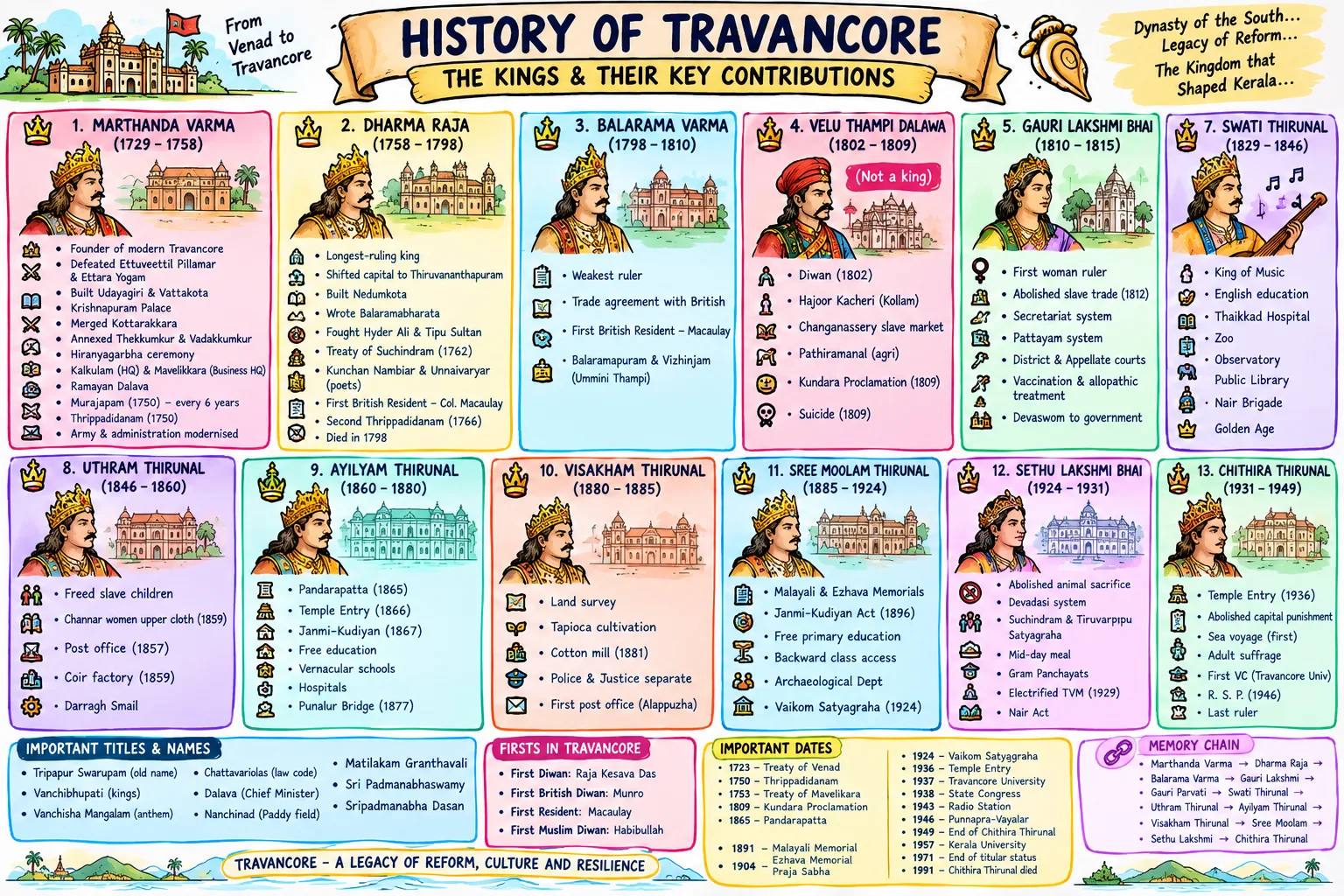
- Anizham Thirunal Veerabaala Marthanda Varma – 1729–1758
- Karthika Thirunal Rama Varma (Dharma Raja) – 1758–1798
- Avittom Thirunal Balarama Varma – 1798–1810
- Gowri Lakshmi Bayi – 1810–1815
- Ruled pending the birth of a son from 1810–1813
- Regent for her newborn son from 1813–1815
- Gowri Parvati Bayi – 1815–1829
- Regent for her nephew
- Swathi Thirunal Rama Varma – 1829–1846
- King from birth in 1813
- Crowned in 1815
- Ruled from 1829–1846
- Uthram Thirunal Marthanda Varma – 1846–1860
- Ayilyam Thirunal Rama Varma – 1860–1880
- Visakham Thirunal Rama Varma – 1880–1885
- Sree Moolam Thirunal Rama Varma – 1885–1924
- Sethu Lakshmi Bayi – 1924–1931
- Regent for her nephew
- Chithira Thirunal Balarama Varma
- Born in 1912
- Succeeded in 1924
- Received full power in 1931
- Ruled until 1949
- Titular Maharajah until 1971
- Died in 1991
2. What are the important general facts about the Travancore dynasty?
Answer:
- Tripapur Swarupam was the old name of the Travancore dynasty.
- Travancore kings were known as Vanchibhupati.
- Vanchisha Mangalam was the anthem of the Kingdom of Travancore.
- The first written code of law in Travancore was Chattavariolas.
- Colonel Munro prepared the Chattavariolas.
- Shanku was the symbol of the Travancore dynasty.
- Chief Ministers of Travancore were known as Dalava or Dewan.
- Nanchinad was known as the “Paddy field of Thiruvithamkur.”
- Matilakam Granthavali is associated with the Travancore dynasty.
- Sri Padmanabhaswamy was the worship idol of Travancore.
- Travancore kings were known as Sripadmanabha Dasan.
3. Who held the important “first” positions in Travancore?
Answer:
- First Dalava: Arumukham Pillai
- First Diwan: Raja Kesava Das
- First British Diwan: Colonel Munro
- First Resident Diwan: Colonel Munro
- First British Resident: Colonel Macaulay
- First Muslim Diwan: Muhammad Habibullah
2. ANIZHAM THIRUNAL MARTHANDA VARMA
1729–1758
4. Why is Anizham Thirunal Marthanda Varma important in Travancore history?
Answer:
- Anizham Thirunal Marthanda Varma is regarded as the founder of modern Travancore.
- He was born in 1706.
- He styled himself as the “Prince of Neyyattinkara.”
- He defeated the eight feudal landlords known as:
- Ettuveettil Pillamar
- Ettara Yogam
- He renovated Udayagiri Kotta.
- He built Vattakotta.
- He built Krishnapuram Palace in Alappuzha.
- The famous Gajendramoksham mural is located in Krishnapuram Palace.
- He merged Kottarakkara with Travancore.
- He annexed Thekkumkur and Vadakkumkur to Travancore.
- He started the temple ceremony called Hiranyagarbha.
- Kalkulam was the headquarters of Travancore during his reign.
- Mavelikkara was his business headquarters.
5. What were the important religious and cultural developments during Marthanda Varma's reign?
Answer:
- Ramayan Dalava was a famous minister of Marthanda Varma.
- Murajapam is an important celebration at the Sri Padmanabhaswamy Temple.
- Murajapam was first introduced in 1750.
- Murajapam is celebrated every six years.
- Bhadradeepam, conducted twice a year, is associated with Murajapam.
- Marthanda Varma led Venad towards modernity.
- Venad became the modern kingdom of Travancore.
- The Travancore army became more powerful during his reign.
6. What were the important wars, territorial expansions and administrative reforms of Marthanda Varma?
Answer:
- The King of Kayamkulam and Marthanda Varma signed the Treaty of Mannar in 1742.
- Veera Kerala Varma, the king of Kottarakkara, died in Marthanda Varma's imprisonment.
- Marthanda Varma captured Kayamkulam (Odanad) through the Purakkad War in 1746.
- He established a layered administrative system in Travancore.
- An individual Pravritti (village) was administered by a Pravarthikar, a village officer acting on behalf of the state.
- A group of villages formed the Mandapathum Vathukkal (Thaluk).
- It was governed by a Karyakar, described in the notes as a prototype of the modern Tahsildar or district revenue officer.
- Marthanda Varma eliminated the feudal barons and established a centralised monarchy.
7. Which poets and officials were associated with Marthanda Varma?
Answer:
- Ramapurathu Waryar and Kunchan Nambiar were prominent poets who lived in Marthanda Varma's kingdom.
- Palliyadi Mallan Sankaran was the revenue minister of Marthanda Varma.
- Krishna Sharma was his chief poet.
8. What was Thrippadidanam and when did Marthanda Varma perform it?
Answer:
- Marthanda Varma performed Thrippadidanam on 3 January 1750.
- He dedicated the kingdom to Lord Sri Padmanabha.
- He thereafter ruled as the “Servant of Padmanabha”, or Padmanabhadasan.
- This act is known as Thrippadidanam.
9. What was the Treaty of Mavelikara of 1753?
Answer:
- The Treaty of Mavelikara was signed in 1753 between Marthanda Varma and the Dutch.
- It was a peace and friendship treaty between the Dutch East India Company and Maharaja Anizham Thirunal Marthanda Varma of Travancore.
- It was signed on 15 August 1753.
- The treaty:
- Marked the end of Dutch political and commercial dominance in Kerala.
- Established an agreement of mutual territorial integrity.
- Required the Dutch not to interfere in the internal affairs of smaller kingdoms.
- Required the Dutch not to form alliances with Travancore's enemies.
10. What was the Battle of Colachel and why was it important?
Answer:
- The Battle of Colachel was fought between Travancore and the Dutch.
- It took place on 10 August 1741.
- Marthanda Varma defeated the Dutch.
- The cause of the war was disputes over trade.
- It was the first time an Asian kingdom defeated a European power, according to the notes.
- It ended Dutch plans for colonial expansion in India.
- The Dutch never regained their former strength and shifted their focus towards Indonesia.
11. Who was Eustachius De Lannoy and what happened to him after the Battle of Colachel?
Answer:
- Eustachius De Lannoy was the Dutch commander defeated by Marthanda Varma at the Battle of Colachel.
- He later became a senior admiral in the Travancore army.
- He trained the Travancore army in modern warfare.
- He was known as “Valiyakappithan.”
- His tomb is located at Udayagirikotta, near Thakkala in Tamil Nadu.
- Udayagirikotta was built by Veera Ravi Varma.
12. What other important facts are associated with Marthanda Varma?
Answer:
- Ammachiplav, where Marthanda Varma hid, is located near Neyyattinkara Sri Krishna Swamy Temple.
- The historical novels Marthandavarma and Dharmaraja were written by C. V. Raman Pillai.
13. What were the important wars, treaties and developments during Marthanda Varma's reign?
Answer:
- Treaty of Venad was signed with the British in 1723.
- Attingal was added to Travancore in 1730.
- In 1742, Marthanda Varma captured Kili Manor.
- Treaty of Mannar was signed in 1742.
- Under the Treaty of Mannar:
- The Kayamkulam ruler agreed to merge a major portion of Kayamkulam with Travancore.
- He agreed to pay 1,000 rupees every year.
- Kayamkulam was captured in 1746 through the Battle of Purakkad.
- During Marthanda Varma's period, the commercial department was known as Mulakumadishsheela.
- The industrialists of Travancore were known as Mulakumadisheelakkar.
- Marthanda Varma established an army called Maravapada.
- Ponmana Anna and Puthan Anna were dams built during his period.
14. Which rulers were associated with the title “Ashoka”?
Answer:
- Marthanda Varma → “Ashoka of Thiruvithamkur”
- Vikramaditya Varaguna → “Ashoka of Kerala”
- Amoghavarshan → “Ashoka of South India”
- Kanishka → “Second Ashoka”
3. KARTHIKA THIRUNAL RAMA VARMA
DHARMA RAJA, 1758–1798
15. What are the important facts about Karthika Thirunal Rama Varma, known as Dharma Raja?
Answer:
- Karthika Thirunal Rama Varma ruled Travancore from 1758 to 1798.
- He was known as:
- Tripapur Muppan
- Chiravayur Muppan
- Kizhavan Raja
- He was a contemporary of Pazassi Raja and Shaktan Thampuran.
- He corresponded with the Pope at the Vatican.
- He built Nedumkota.
- He was the longest-ruling ruler in Travancore.
- He shifted the capital of Travancore from Padmanabhapuram (Kalkulam) to Thiruvananthapuram.
- He wrote Balaramabharata, a work based on the Natya Shastra, also known as Balarama Bharatam.
- He was the ruler of Travancore during the invasions of Kerala by Hyder Ali and Tipu Sultan.
- He built Kulashekhara Mandapam in Padmanabhapuram Palace.
16. What was the Treaty of Suchindram?
Answer:
- The Treaty of Suchindram was signed in 1762.
- It was an agreement between the native kingdoms of Cochin and Travancore.
- The agreement was signed at the Suchindram Temple.
17. What are the other important facts associated with Dharma Raja?
Answer:
- Colonel Macaulay, who served from 1795–1810, was the first British Resident of Travancore.
- Kunchan Nambiar and Unnaivaryar were prominent poets in the court of Karthika Thirunal.
- In 1766, Dharma Raja performed the second Thrippadidanam.
- Tipu Sultan attacked Nedungota in 1789.
- Dharma Raja died in 1798.
- His major plays were:
- Subhadraharana
- Rajasuyam
- Kalyana Saugandhikam
- Panchali Swayamvaram
- Gandharva Vijayam
4. RAJA KESAVA DAS
18. Who was Raja Kesava Das and what were his major contributions?
Answer:
- Raja Kesava Das was the first Prime Minister of Travancore to assume the post of Dewan.
- He was known as “Valia Divanji.”
- His real name was Kesavapillai.
- He received the title “Raja” from Lord Mornington.
- Important places built by Raja Kesava Das include:
- Alappuzha Town
- Chala Kampolam
- Varkala Town was founded by Ayyappan Marthandapilla.
- MC Road (State Highway 1) was built by Diwan Rajakesava Das.
- The route mentioned is Kesavadasapuram–Angamali.
5. AVITTOM THIRUNAL BALARAMA VARMA
1798–1810
19. What are the important facts about Avittom Thirunal Balarama Varma?
Answer:
- Avittom Thirunal Balarama Varma ruled from 1798 to 1810.
- He is described in the notes as the weakest ruler in the history of Travancore.
- During his reign, a trade agreement was signed between Travancore and the British East India Company.
- Macaulay was the first Resident of Travancore.
- Balaramapuram and Vizhinjam Harbour were built by Ummini Thampi, who was the Diwan of Avittom Thirunal.
6. VELU THAMPI DALAWA
20. Who was Velu Thampi Dalawa?
Answer:
- Velu Thampi Dalawa was the powerful minister of Avittom Thirunal Balarama Varma.
- Kalkulam in Kanyakumari was his birthplace.
- His real name was Thalakulath Velayudhan Chempakaraman Thampi.
- He became the Dewan of Thiruvithankur in 1802.
- He led the anti-British struggles in Thiruvithankur.
- He was assisted by Paliath Achan, the minister of Kochi, in the struggle against the British.
21. What were the major administrative and economic activities of Velu Thampi Dalawa?
Answer:
- He established Hajoor Kacheri, the secretariat, in Kollam.
- He founded the Changanassery slave market.
- He made Pathiramanal Island in Vembanad Lake arable.
- He sacrificed his life in 1809.
- He committed suicide at Mannadi Temple in Pathanamthitta.
- His memorial is located at Mannadi.
22. What was the Kundara Proclamation?
Answer:
- Velu Thampi Dalawa issued the Kundara Proclamation.
- It was issued on 11 January 1809.
- The corresponding Malayalam calendar date given is 984 Makaram 1.
- The Ilampallur Temple was the temple where the Kundara Proclamation was witnessed.
7. UMMINI THAMPI
23. What are the important facts about Ummini Thampi?
Answer:
- Ummini Thampi became the Diwan of Travancore after Velu Thampi Dalawa.
- He built Vizhinjam Port.
- He established courts called Insuwaf Kacherikal in Travancore.
- He started the police force in Travancore.
- Before the police force, there was a force of Nair soldiers.
- In 1810, he founded the weaving town at Balaramapuram.
8. AYILYAM THIRUNAL GAURI LAKSHMI BHAI
1810–1815
24. What are the important facts about Ayilyam Thirunal Gauri Lakshmi Bhai?
Answer:
- Ayilyam Thirunal Gauri Lakshmi Bhai ruled from 1810 to 1815.
- She was the first woman ruler of Travancore.
- She was the ruler who ruled for the shortest period in Travancore.
- She abolished the slave trade in Travancore.
- Slave trade was abolished on 5 December 1812.
- She implemented the secretarial system of administration.
- She introduced the Pattayam system, or land deed system.
- She established District Courts and Appellate Courts in Travancore.
- She introduced vaccination and allopathic treatment.
- During her reign, Devaswom administration was taken over by the government.
- Swati Thirunal was the son of Rani Gauri Lakshmi Bhai.
9. COLONEL MUNRO
25. Who was Colonel Munro and what were his important positions?
Answer:
- Colonel Munro was the Diwan of Travancore during the reign of Rani Gauri Lakshmi Bhai.
- He became Diwan after Ummini Thampi.
- He was the first European Diwan in Travancore.
- He was appointed as Travancore Resident in 1811.
- He was the first Resident of Travancore.
- He was the first non-Hindu Diwan in the history of Travancore.
- He prepared the legal code called Chattavariolas.
- He served as Diwan in both Travancore and Kochi.
10. UTHRATTATHI THIRUNAL RANI GAURI PARVATI BHAI
1815–1829
26. What were the major reforms of Rani Gauri Parvati Bhai?
Answer:
- Rani Gauri Parvati Bhai ruled from 1815 to 1829.
- She was the first regent ruler of Travancore.
- She abolished export and import duties.
- She declared that education was the duty of the government.
- She made primary education compulsory in Travancore.
- Educational colleges were taken over by the government.
- Parvati Puthanar was constructed during her period.
- Parvati Puthanar is a canal connecting:
- Veli Backwater
- Kadinamkulam Backwater
- She allowed lower castes to wear gold, silver and other jewellery.
- She issued a proclamation allowing everyone in her kingdom to tile the roofs of their houses.
- Coffee cultivation was introduced into Travancore for the first time.
- She abolished Uzhiyam Vela.
- She was the ruler during the period when the London Mission Society began its work in Travancore.
- The London Mission Society was first started at Nagercoil.
11. SWATI THIRUNAL RAMA VARMA
1829–1846
27. What are the important titles and cultural achievements of Swati Thirunal?
Answer:
- Swati Thirunal Rama Varma ruled from 1829 to 1846.
- He was known as:
- Dakshina Bhojan
- Garbhashreeman
- He was known as the “King of Musicians” and “Musician of Kings.”
- He was fond of Carnatic music and Veena Vayana.
- He abolished the ancient punishment method called Suchindram Kaimuk.
- He started English education in Travancore.
- Mohiniyattam flourished during his reign.
- He managed more than twenty languages.
- The Travancore army was given the name Nair Brigade during his reign.
- His reign is known as the “Golden Age of Modern Travancore.”
28. What were Swati Thirunal's administrative and educational contributions?
Answer:
- He moved Hajoor Kacheri from Kollam to Thiruvananthapuram.
- He established the English School in Travancore in 1834.
- The school later became:
- Raja's Free School
- University College
- Swati Thirunal was the first king of Kerala to appear on a postage stamp.
- Iraimman Thampi was his head poet.
- “Omanathingal Kidavo” was composed by Iraimman Thampi.
29. Who were the Thanjavur Nalvar associated with Swati Thirunal?
Answer:
- The head scholars of Swati Thirunal's congregation were known as the Thanjavur Nalvar.
- The members were:
- Vadivelu
- Ponnaiah
- Chinnaiah
- Sivanandan
- They were collectively known as the Thanjavur Nalvar Sangam.
30. What were the important “firsts” and institutions associated with Swati Thirunal?
Answer:
First in Travancore:
- Census → Swati Thirunal, 1836
- Regular Census → Ayilyam Thirunal, 1875
Institutions established by Swati Thirunal:
- Thaikkad Hospital
- Horsemanship / Kuthira Malika
- Trivandrum Zoo
- Observatory
- Travancore Public Library
- Nakshathra Bungalow
- Court of Munsif
Departments initiated by Swati Thirunal:
- Irrigation Department
- Engineering Department
- Department of Agriculture
12. UTHRAM THIRUNAL MARTHANDA VARMA
1847–1860
31. What are the important reforms and events associated with Uthram Thirunal Marthanda Varma?
Answer:
- Uthram Thirunal Marthanda Varma ruled from 1847 to 1860.
- He issued a proclamation freeing the children of slaves.
- He gave permission to Channar women to wear upper clothes on 26 July 1859.
- He established the Pen Pallikkoodam in Thiruvananthapuram.
- He was the King of Travancore during the 1857 Revolt / Sepoy Mutiny.
- He was the ruler during the establishment of the post office system in Travancore.
- The first post office in Kerala was established at Alappuzha in 1857.
- He was the ruler when the first coir factory in Kerala was established at Alappuzha in 1859.
- Darragh Smail, the first coir factory in Alappuzha, was established by:
- James Darragh
- Henry Smail
- James Darragh was an American of Irish descent.
13. AYILYAM THIRUNAL RAMA VARMA
1860–1880
32. What were the major reforms of Ayilyam Thirunal Rama Varma?
Answer:
- Ayilyam Thirunal Rama Varma ruled from 1860 to 1880.
- He introduced the Pandarapatta Proclamation in 1865.
- The Pandarapatta Declaration is known as the “Magna Carta of Travancore.”
- The Temple Entry Proclamation is known as the “Magna Carta of Kerala.”
- He introduced the Janmi-Kudiyan Valambaram in 1867.
- He was the ruler during the confiscation of the newspaper Sandishtavadi.
- Travancore received the title “Mathruka Rajya” or Model State during his reign.
- He started vernacular schools in Travancore.
- He instituted a special class for legal studies.
- Queen Victoria bestowed the title of “Maharaja” on Ayilyam Thirunal in 1866.
33. Who was T. Madhava Rao and what did he do during Ayilyam Thirunal's reign?
Answer:
- T. Madhava Rao was the famous Diwan of Ayilyam Thirunal.
- In 1860, he started the Public Works Department in Travancore.
- In 1861, the government opened the Anchal (post office) to the public.
- Important people in Ayilyam Thirunal's court included:
- Kerala Varma Valiya Koi Thampuran
- A. R. Rajaraja Varma
- Raja Ravi Varma
34. What institutions and buildings were established during Ayilyam Thirunal's reign?
Answer:
Established during his reign:
- Thiruvananthapuram District General Hospital
- Civil Hospital
- Mental Hospital
- Arts College
- Latex-related institution
- Kollam–Punalur Suspension Bridge, 1877
- Secretariat Building, Thiruvananthapuram
Important facts:
- Albert Henry was the architect of the Punalur Suspension Bridge.
- William Barton was the architect of the Secretariat Building.
- The Secretariat Building was inaugurated in 1869.
- Swati Thirunal worked hard to obtain the status of Mathruka Rajyam (Model State) for Travancore.
- Ayilyam Thirunal was the ruler when Travancore actually received the status of Mathruka Rajyam.
14. VISAKHAM THIRUNAL RAMA VARMA
1880–1885
35. What are the important facts about Visakham Thirunal?
Answer:
- Visakham Thirunal Rama Varma ruled from 1880 to 1885.
- He was famous as a scholar.
- He was the ruler at the time of drafting the Mullaperiyar Lease Agreement.
- He described the Mullaperiyar lease as being “written with my heart's blood.”
- Ramayankar was his famous minister.
- A complete land survey was conducted in Travancore during his reign.
- He encouraged the cultivation of tapioca in Travancore.
- Sree Visakh is a variety of tapioca named in his memory.
36. What administrative and agricultural developments occurred during Visakham Thirunal's reign?
Answer:
- Visakham Thirunal separated police and administration of justice in Travancore.
- The first cotton mill in Travancore was established in 1881 in Kollam district.
- Irrigation projects in Nanchinadu were expanded.
- Nanchinad is known as the “Paddy field of Thiruvithamkur.”
15. SREE MOOLAM THIRUNAL RAMA VARMA
1885–1924
37. What were the major social and political events during Sree Moolam Thirunal's reign?
Answer:
- Sree Moolam Thirunal Rama Varma ruled from 1885 to 1924.
- He was the ruler to whom the:
- Malayali Memorial of 1891
- First Ezhava Memorial of 1896
were submitted.
- The Malayali Memorial was submitted on 1 January 1891.
- K. P. Shankara Menon was the first person to sign it.
- G. P. Pillai was the second to sign it.
- Dr. Palpu was the third to sign it.
- The First Ezhava Memorial was submitted on 3 September 1896.
- He passed the Janmi-Kudiyan Regulation Act in 1896.
- He made primary education free.
- He allowed children from backward communities to enter government schools.
- He started the Archaeological Research Department.
- He was the ruler when the Vaikom Satyagraha began on 30 March 1924.
38. What are the important facts about representation and administration during Sree Moolam Thirunal's reign?
Answer:
- Ayyankali was the first Harijan to become a member of the Sree Moolam Praja Sabha.
- P. Rajagopalachari was the Diwan who exiled Swadesabhimani Ramakrishna Pillai.
- The Travancore Legislative Council came into force in 1888.
- In 1904, the Travancore Legislative Council became the Sree Moolam Praja Sabha.
- The first meeting of the Sree Moolam Praja Sabha was held in 1904 at VJT Hall.
16. MULLAPERIYAR DAM
39. What are the important facts about the Mullaperiyar Lease Agreement and Dam?
Answer:
- Visakham Thirunal was the king when the Mullaperiyar Lease Agreement was written.
- Sree Moolam Thirunal was the king when the Mullaperiyar Dam was inaugurated in 1895.
- Ramayankar was the Diwan of Travancore who signed the Periyar Lease Agreement for the Mullaperiyar Dam.
40. Which important institutions were started during the era of Sree Moolam Thirunal?
Answer:
Important institutions and buildings started during his period included:
- Finger Print Bureau
- Handwriting Library / Hastha Likhitha Library
- Women's College
- Law College
- Ayurveda College
- Sanskrit College
- Durguna Parihara Padasala
- Kanakakkunnu Palace
- Ayyankali Hall / VJT Hall
17. PURADAM THIRUNAL SETHULAKSHMI BHAI
1924–1931
41. What were the major social reforms of Sethu Lakshmi Bhai?
Answer:
- Puradam Thirunal Sethu Lakshmi Bhai ruled from 1924 to 1931 as Regent.
- She abolished:
- Animal sacrifice
- Devadasi system in temples
- The Devadasi system was also called Kudikari Sampradayam.
- She was the ruler during:
- Suchindram Satyagraha
- Tiruvarppu Satyagraha
- A memorandum connected with the Vaikom Satyagraha was submitted to her.
- She electrified Thiruvananthapuram in 1929.
- She ruled as Regent because Sri Chithira Thirunal was a minor.
- Gram Panchayats were formed during her period.
- She launched a free mid-day meal scheme.
- She granted freedom of movement to Avarnas through temple streets in Travancore.
- She was the only ruler of Travancore visited by Mahatma Gandhi, in 1925.
- She was the ruler when the Nair Act came into force.
42. What were the other important developments during Sethu Lakshmi Bhai's regency?
Answer:
- She ended Marumakkathayam in Travancore.
- The Travancore Newspaper Act was passed in 1926.
- Sree Moolam Thirunal was the ruler when the Vaikom Satyagraha began.
- Sethu Lakshmi Bhai was the ruler when the Vaikom Satyagraha ended.
18. SRI CHITHIRA THIRUNAL BALARAMA VARMA
1931–1949
43. What are the major achievements and reforms of Sri Chithira Thirunal?
Answer:
- Sri Chithira Thirunal Balarama Varma ruled from 1931 to 1949.
- He was the last ruler of Travancore.
- He issued the Temple Entry Proclamation on 12 November 1936.
- He ordered the abolition of capital punishment in Travancore.
- He was the first King of Travancore to make a sea voyage.
- He introduced adult suffrage in Travancore.
- He was the first Chancellor of Travancore University.
- He was the first ruler of Kerala to visit the Pope.
- He enacted the Widow Remarriage Act in 1938.
- He was the ruler during the Punnapra-Vayalar Struggle in 1946.
- He later held the position of Rajapramukhan of Thirukochi.
- He was the ruler of Travancore when India became independent.
44. What were the important political developments during Chithira Thirunal's reign?
Answer:
- V. S. Subhamanya Iyer was the chairman of the Temple Entry Study Committee appointed during Chithira Thirunal's reign.
- Muhammad Habibullah was the only Muslim Diwan of Travancore.
- The Travancore State Congress was formed in 1938.
- Pattom Thanu Pillai led the formation of the Travancore State Congress.
- Chithira Thirunal died in 1991 at Kowdiar Palace.
- His statue was installed at Thiruvananthapuram University College.
45. Who were the last Diwans of Travancore?
Answer:
- C. P. Ramaswami Iyer was the last Diwan of Travancore.
- P. G. N. Unnithan was the last acting Diwan of Travancore.
- Muhammad Habibullah was the only Muslim Diwan of Travancore.
19. IMPORTANT KERALA STATE MANUALS
46. Who wrote the major state manuals mentioned in the notes?
Answer:
- Travancore State Manual → V. Nagamaiah
- Kochi State Manual → C. Achyuthamenon
- Malabar Manual → William Logan
20. INSTITUTIONS ESTABLISHED DURING CHITHIRA THIRUNAL'S REIGN
47. Which major industries and institutions were established during the reign of Sri Chithira Thirunal?
Answer:
The following were established during his reign:
- Travancore Rubber Works
- Kundara Clay Factory
- FACT
- Punalur Plywood Factory
- Nellikampetti Wildlife Sanctuary
- Travancore Public Service Commission
- Travancore University
- State Transport Service
- Thiruvananthapuram Radio Station
Important dates:
- Nellikampetti Wildlife Sanctuary → 1934
- It was the first wildlife sanctuary in Kerala.
- Travancore Public Service Commission → 1936
- Travancore University → 1937
- Travancore University became Kerala University in 1957.
- State Transport Service → 1938
- Thiruvananthapuram Radio Station → 1943
21. SIR C. P. RAMASWAMI IYER
48. Who was Sir C. P. Ramaswami Iyer and what were his major roles?
Answer:
- C. P. Ramaswami Iyer was the last Diwan of Travancore.
- He was the first Vice Chancellor of Travancore University.
- He implemented the American model of governance in Travancore.
- He was the Diwan who made the “Independent Travancore Declaration.”
- K. C. S. Mani attempted to assassinate C. P. Ramaswami Iyer.
Timeline to remember
- Marthanda Varma → 1729–1758
- Dharma Raja → 1758–1798
- Balarama Varma → 1798–1810
- Gauri Lakshmi Bhai → 1810–1815
- Gauri Parvati Bhai → 1815–1829
- Swati Thirunal → 1829–1846
- Uthram Thirunal → 1846–1860
- Ayilyam Thirunal → 1860–1880
- Visakham Thirunal → 1880–1885
- Sree Moolam Thirunal → 1885–1924
- Sethu Lakshmi Bhai → 1924–1931
- Chithira Thirunal → 1931–1949
- 1723 → Treaty of Venad with British
- 1730 → Attingal added to Travancore
- 1741 → Battle of Colachel
- 1742 → Treaty of Mannar
- 1746 → Kayamkulam captured
- 1750 → Thrippadidanam + Murajapam
- 1753 → Treaty of Mavelikara
- 1762 → Treaty of Suchindram
- 1789 → Tipu Sultan attacked Nedungota
- 1802 → Velu Thampi became Dewan
- 1809 → Kundara Proclamation
- 1812 → Abolition of slave trade
- 1811 → Munro appointed Travancore Resident
- 1834 → English School established by Swati Thirunal
- 1836 → First Census
- 1857 → First post office in Kerala at Alappuzha
- 1859 → First coir factory in Kerala at Alappuzha
- 1865 → Pandarapatta Proclamation
- 1866 → Ayilyam Thirunal received title Maharaja
- 1867 → Janmi-Kudiyan Valambaram
- 1869 → Secretariat Building inaugurated
- 1875 → Regular Census
- 1877 → Kollam-Punalur Suspension Bridge
- 1888 → Travancore Legislative Council
- 1891 → Malayali Memorial
- 1895 → Mullaperiyar Dam inaugurated
- 1896 → First Ezhava Memorial + Janmi-Kudiyan Regulation Act
- 1904 → Sree Moolam Praja Sabha
- 1924 → Vaikom Satyagraha began
- 1926 → Travancore Newspaper Act
- 1929 → Thiruvananthapuram electrified
- 1934 → First wildlife sanctuary in Kerala
- 1936 → Temple Entry Proclamation + Travancore PSC
- 1937 → Travancore University
- 1938 → Travancore State Congress + State Transport Service
- 1943 → Thiruvananthapuram Radio Station
- 1946 → Punnapra-Vayalar Struggle
- 1949 → End of Chithira Thirunal's reign
- 1957 → Travancore University became Kerala University
- 1971 → Chithira Thirunal ceased to be Titular Maharajah
- 1991 → Chithira Thirunal died