Portuguese in Kerala - Arrival of Europeans in Kerala | PSC Notes
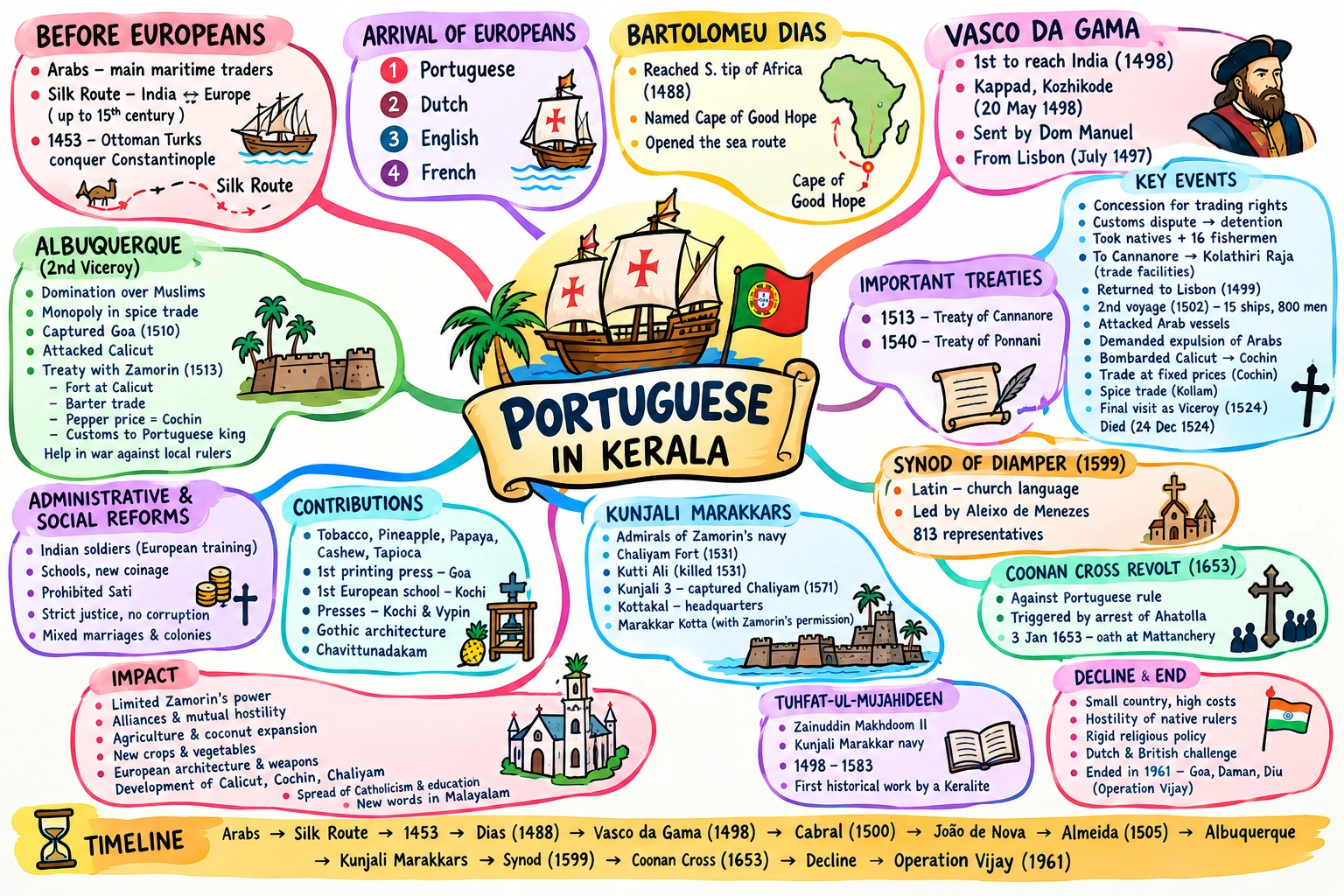
1. Who were the major foreign sea traders with Kerala before the arrival of Europeans?
Answer:
- The Arabs were the major foreign sea traders with Kerala before the Europeans.
- The major trade route between India and Europe was the Silk Route.
- The Silk Route remained important up to the first half of the 15th century.
- In 1453, the Ottoman Turks conquered Constantinople, encouraging Europeans to search for alternative sea routes to India.
2. In what order did the major European powers arrive in Kerala by sea?
Answer:
- Portuguese
- Dutch
- English
- French
3. Who was Bartolomeu Dias and what was his significance?
Answer:
- Bartolomeu Dias was a Portuguese navigator.
- He reached the southern tip of Africa in 1488.
- He named it the Cape of Good Hope.
- He was the first European to sail around the southernmost tip of Africa.
- His voyage helped open the sea route towards India.
4. Who was Vasco da Gama and when did he first reach Kerala?
Answer:
- Vasco da Gama was a Portuguese navigator.
- He was the first Portuguese captain to reach India by sea.
- He reached Kappad near Kozhikode on 20 May 1498.
- He was sent by Dom Manuel, King of Portugal.
- He began his voyage from Lisbon in July 1497.
- His ships included:
- São Gabriel
- São Raphel
- São Bariyo
5. What happened when Vasco da Gama first arrived at Calicut?
Answer:
- The Zamorin of Calicut received Vasco da Gama with traditional respect.
- The gifts brought by Gama did not impress the Zamorin.
- Arab merchants opposed the Portuguese presence.
- Despite this opposition, Gama obtained a letter of concession for trading rights.
- The Portuguese were unable to pay the required customs duties and the price of goods in gold.
- Calicut officials temporarily detained Portuguese agents as security for payment.
- Gama became angry and forcibly took some natives and 16 fishermen.
- He then left for Cannanore.
- The Kolathiri Raja received him and offered trading facilities at Kannur.
- Gama returned to Lisbon in 1499.
6. What happened during Vasco da Gama's second voyage to Kerala in 1502?
Answer:
- Vasco da Gama returned in 1502 with 15 ships and about 800 men.
- He attacked and captured Arab vessels on the way to Cannanore.
- The Zamorin offered to forget the previous Portuguese actions and take action against those responsible for the conflict.
- Gama demanded the expulsion of all Arab merchants from Calicut.
- The Zamorin refused.
- Gama then bombarded Calicut.
- He proceeded to Cochin, where he made a trade agreement with the Cochin ruler at fixed prices.
- The ruler of Kollam also invited Gama for spice trade.
- Gama accepted the invitation with the permission of the Cochin king.
- On his return, he encountered the Zamorin's fleet but escaped without serious loss.
7. What were the important facts about Vasco da Gama's final visit and death?
Answer:
- Gama made his third and final visit to Kerala in 1524.
- He came as the Viceroy of Portuguese India.
- He died on 24 December 1524.
- His remains were taken to Portugal in 1539.
- Vasco da Gama is also the name of a place in Goa.
8. Who was Pero da Covilha?
Answer:
- Pero da Covilha was a Portuguese who, according to the traditional account in the notes, came to Kerala.
9. Who was Pedro Álvares Cabral and what did he do in Kerala?
Answer:
- Pedro Álvares Cabral led the second Portuguese expedition to India.
- He reached Kozhikode in 1500 with six ships.
- The Portuguese obtained permission to establish a factory at Calicut.
- Conflict developed with Arab merchants.
- After the massacre of the crew of an Arab vessel, Cabral was forced to move to Cochin.
- The Portuguese objectives were:
- Trade monopoly
- Spread of Christianity
- The Zamorins opposed these objectives.
- The Cochin Raja warmly received Cabral in 1500 and provided trading facilities.
- The rulers of Quilon and Cannanore promised assistance.
- At Cannanore, the Kolathiri Raja helped Cabral load cargo.
- Cabral eventually returned to Portugal.
10. What is important to remember about João de Nova?
Answer:
- João de Nova was associated with the Third Armada.
- He had advance information about the hostility of the Zamorin.
- Therefore, he avoided Calicut.
- He landed at Cochin and Cannanore.
11. Who was Francisco de Almeida and what was his major policy?
Answer:
- Francisco de Almeida was the first Viceroy of India.
- He was appointed in 1505 by the Portuguese King.
- The St Angelo Fort was built in 1505.
- Almeida introduced the Blue Water Policy.
- Its main objective was to:
- Strengthen the Portuguese navy
- Establish Portuguese supremacy over the Indian Ocean
- Portuguese traders were killed at Quilon.
- Almeida's son Lawrence led Portuguese forces and destroyed Calicut ships.
12. Which major naval forces were defeated by Francisco de Almeida?
Answer:
Almeida defeated a joint fleet consisting of forces from:
- Mamluk Burji Sultan of Egypt
- Ottoman Empire
- Zamorin of Calicut
- Sultan of Gujarat
The defeat weakened Egyptian and Ottoman influence in the Indian Ocean and helped the Portuguese establish a strong trading position in Indian waters.
13. Who was Albuquerque and what were his major objectives?
Answer:
- Albuquerque was the second Viceroy of Portuguese India.
- His major objectives were:
- Domination over Muslim powers
- Monopoly over the spice trade
- He fought the ruler of Bijapur.
- He captured Goa in 1510.
- He also attacked Calicut during his early period.
14. What were the important terms of Albuquerque's treaty with the Zamorin in 1513?
Answer:
The 1513 treaty included:
- Portuguese could construct a fort at Calicut at a place of their choice.
- Portuguese could conduct business through barter.
- The price of pepper would be the same as at Cochin.
- A portion of customs revenue would be paid to the Portuguese king as tribute.
- Compensation would be provided for earlier Portuguese losses.
- Portuguese would help the Zamorin in wars against local rulers.
- The Cochin Raja protested against the agreement.
15. What administrative and social reforms were introduced by Albuquerque?
Answer:
- Indians were recruited into the Portuguese army.
- Indians were trained in European military methods.
- Schools were established.
- New coinage was introduced.
- Sati was prohibited.
- Strict administration of justice was introduced.
- Portuguese corruption was not tolerated.
- Marriages between Portuguese men and local women were encouraged.
- Mixed colonies were established to strengthen Portuguese power.
16. What are the important facts about Portuguese forts and colonies in India?
Answer:
- Fort Manuel was constructed in 1503 and is traditionally described in these notes as the earliest European fort in India.
- Major Portuguese colonies included:
- Goa
- Daman and Diu
- Manuel Antonio Vassalo e Silva was the last Governor-General of Portuguese India.
17. Who were the Kunjali Marakkars and why are they important?
Answer:
- The Kunjali Marakkars were the admirals of the Zamorin's navy.
- The four important Kunjalis were:
- Kutti Ahmed Ali
- Kutti Pokker Ali
- Pattu Kunjali
- Mohammed Ali
- They challenged Portuguese naval supremacy in Indian waters.
- They are particularly important for their naval resistance against the Portuguese.
18. What were the important events connected with Kutti Ali and the early Kunjalis?
Answer:
- In 1524, the Calicut fleet under Kutti Ali inflicted heavy damage on Portuguese vessels.
- Kutti Ali used small, fast, armed boats.
- He developed sea guerrilla warfare.
- Portuguese commander Henrique de Menezes launched an expedition against him.
- Several Portuguese ships were destroyed at Ponnani.
- In 1525, the Portuguese attacked Pantalayani Kollam, an important Kunjali stronghold.
- Kutti Ali was killed in 1531.
- He was succeeded by Kunjali II.
- Kunjali II reorganised the naval forces with Pachachi Marakkar.
19. What are the most important facts about Chaliyam Fort and Kunjali III?
Answer:
- In 1531, the Portuguese built a fort at Chaliyam with the consent of the Raja of Tanur.
- Chaliyam Fort helped the Portuguese re-establish their position in the region.
- Kunjali III captured Chaliyam Fort in 1571.
- Chaliyam Fort was described as “a pistol held at the Zamorin's throat.”
- The fort had been built by Nuno da Cunha, Governor of Portuguese possessions in India from 1529–1538.
- The headquarters of the Kunjalis was Kottakal.
- After the Portuguese were expelled from Chaliyam, the Kunjalis became extremely powerful.
- Kunjali III built Marakkar Kotta at Kottakal with the permission of the Zamorin.
20. What happened between Kunjali IV, the Zamorin and the Portuguese?
Answer:
- The Portuguese later received permission to establish a factory at Ponnani.
- The Zamorin also allowed them to establish a church there.
- The Marakkars opposed these decisions.
- Kunjali IV became chief in 1595.
- He strengthened the Kottakal fortress.
- He openly challenged the authority of the Zamorin.
- The conflict between Kunjali IV and the Zamorin increased.
- The Portuguese supported the Zamorin and attacked Kunjali's fort.
- Kunjali surrendered to the Zamorin on the condition that he would not be handed over to the Portuguese.
- The Zamorin broke the promise and handed Kunjali over to the Portuguese.
- Kunjali IV was executed.
21. What are the important facts associated with Kunjali Marakkar in modern times?
Answer:
- INS Kunjali is a naval training centre at Mumbai.
- A Kunjali Marakkar monument is located at Kottakal.
- A 2000 stamp was issued in memory of Kunjali Marakkar.
22. What were the important Portuguese-Zamorin treaties?
Answer:
- 1513: Treaty of Cannanore according to the notes.
- 1540: Treaty of Ponnani.
23. What were the major contributions of the Portuguese to Kerala and India?
Answer:
The Portuguese introduced or popularised:
- Tobacco cultivation
- Pineapple
- Papaya
- Cashew
- Tapioca
- Printing press
- European school
- Gothic architecture
- Chavittunadakam
Important institutions:
- First printing press at Goa
- Printing presses at Kochi and Vypin
- India's first European school at Kochi
24. What was the political impact of Portuguese rule in Kerala?
Answer:
- Portuguese activities limited the power of the Zamorin.
- They formed alliances with the enemies of the Zamorin.
- Their interventions increased hostility among local rulers.
- These political divisions later helped the Mysore Sultans in their conquest of Kerala.
25. What was the agricultural and economic impact of the Portuguese?
Answer:
- Portuguese encouraged agriculture.
- They introduced scientific and innovative agricultural practices.
- Productive varieties of coconut were imported.
- Coconut cultivation expanded.
- The coir trade flourished.
- They introduced or popularised:
- Papaya
- Pineapple
- Cashew
- Watermelon
- Indian beans
- Guava
26. What was the architectural and military impact of Portuguese rule?
Answer:
Architecture
- European architectural styles appeared in churches and residential buildings.
- European-style bungalows became popular.
Military
- European weapons and military technology were introduced.
- Construction of forts became more common.
- Keralites learned the use and manufacture of:
- Guns
- Cannons
27. What was the impact of Portuguese rule on towns and urban development?
Answer:
- Portuguese built new towns and markets.
- Calicut, Cochin and Chaliyam developed.
- Older centres such as Kollam and Kodungalloor declined in importance.
28. What were the religious and educational impacts of Portuguese rule?
Answer:
- Portuguese promoted Roman Catholicism.
- Colleges were established at:
- Kochi
- Angamaly
- Portuguese and Latin languages gained importance.
- Printing presses were established at Kochi and Vypin.
29. What was the cultural impact of Portuguese rule in Kerala?
Answer:
- Chavittunadakam developed as a blend of Portuguese and Kerala cultural traditions.
- It has similarities with Kathakali.
- Portuguese influence also introduced European styles of dress, architecture and various objects into Kerala society.
30. Which Malayalam words are associated with Portuguese influence?
Answer:
Important examples include:
- Lelam
- Chavi
- Vijagiri
- Alamara
- Verantha
- Mesha
- Chaya
- Kasera
- Vikari
31. What was the Synod of Diamper?
Answer:
- The Synod of Diamper was held on 20 June 1599.
- It was led by Aleixo de Menezes, the Latin-rite Archbishop of Goa.
- The Portuguese considered the Pope the supreme head of the Christian faith.
- The Synod imposed major changes on the St Thomas Christians.
- The church language was changed from Syriac to Latin.
- Around 813 representatives participated.
32. What was the Coonan Cross Revolt of 1653?
Answer:
- The Coonan Cross Oath took place on 3 January 1653 at Mattanchery.
- Members of the St Thomas Christian community publicly declared that they would not submit to Portuguese domination.
- It became a major turning point in the relationship between the St Thomas Christians and the Portuguese.
- A major trigger was the imprisonment of Ahatolla, a Syrian priest from Babylon.
- A rumour spread that the Portuguese had murdered Ahatolla at Mylapore.
- This contributed to the revolt against Portuguese religious and political interference.
33. What is Tuhfat-ul-Mujahideen?
Answer:
- Tuhfat-ul-Mujahideen was written by Zainuddin Makhdoom II.
- It describes the struggle between the Mappila Muslims of Malabar and South Canara and Portuguese colonial forces.
- It deals particularly with the 16th-century resistance.
- It is considered, according to the notes, the first historical work of Kerala authored by a Keralite.
- It describes the resistance of the Kunjali Marakkar navy and the Zamorin of Calicut against Portuguese attempts to colonise the Malabar coast.
- It covers approximately 1498–1583.
- It also provides information about:
- Chronology
- Social life
- Customs
- Family structure
34. Why did Portuguese power decline in Kerala and India?
Answer:
The major reasons included:
- Portugal was a small country and found it difficult to maintain a large overseas empire.
- Portuguese activities created hostility among native rulers.
- Their reputation as aggressive sea powers created opposition.
- Their rigid religious policies made them unpopular among sections of Hindus and Muslims.
- The arrival of the Dutch and British created strong competition.
- Portuguese power gradually declined as other European powers became stronger.
35. What is Operation Vijay and when did Portuguese rule finally end?
Answer:
- Operation Vijay was the Indian military operation to end Portuguese rule in Goa, Daman and Diu.
- It took place in December 1961.
- The key date is 19 December 1961.
- Portuguese rule in these territories ended after the operation.
- According to the notes, V. K. Krishna Menon described it as a “Police action.”
- The Portuguese were therefore the first major European power to arrive in India by sea and remained in parts of India until 1961.
Timeline of Portuguese in Kerala
- 1453 → Ottoman Turks conquered Constantinople
- 1488 → Bartolomeu Dias → Cape of Good Hope
- 1498 → Vasco da Gama → Kappad
- 20 May 1498 → Vasco da Gama reached Kozhikode
- 1500 → Pedro Álvares Cabral
- 1505 → Francisco de Almeida → 1st Viceroy + Blue Water Policy
- 1510 → Albuquerque captured Goa
- 1513 → Treaty of Cannanore
- 1524 → Vasco da Gama's final visit and death
- 1524 → Kutti Ali damaged Portuguese fleet
- 1525 → Portuguese attacked Pantalayani Kollam
- 1531 → Portuguese built Chaliyam Fort
- 1571 → Kunjali III captured Chaliyam Fort
- 1540 → Treaty of Ponnani
- 1595 → Kunjali IV became chief
- 1599 → Synod of Diamper
- 1653 → Coonan Cross Revolt
- 1498–1583 → Period covered in Tuhfat-ul-Mujahideen
- 1961 → Operation Vijay
- 19 December 1961 → End of Portuguese rule in Goa, Daman and Diu