Social and Religious Reform movement - Kerala Renaissance | PSC Notes
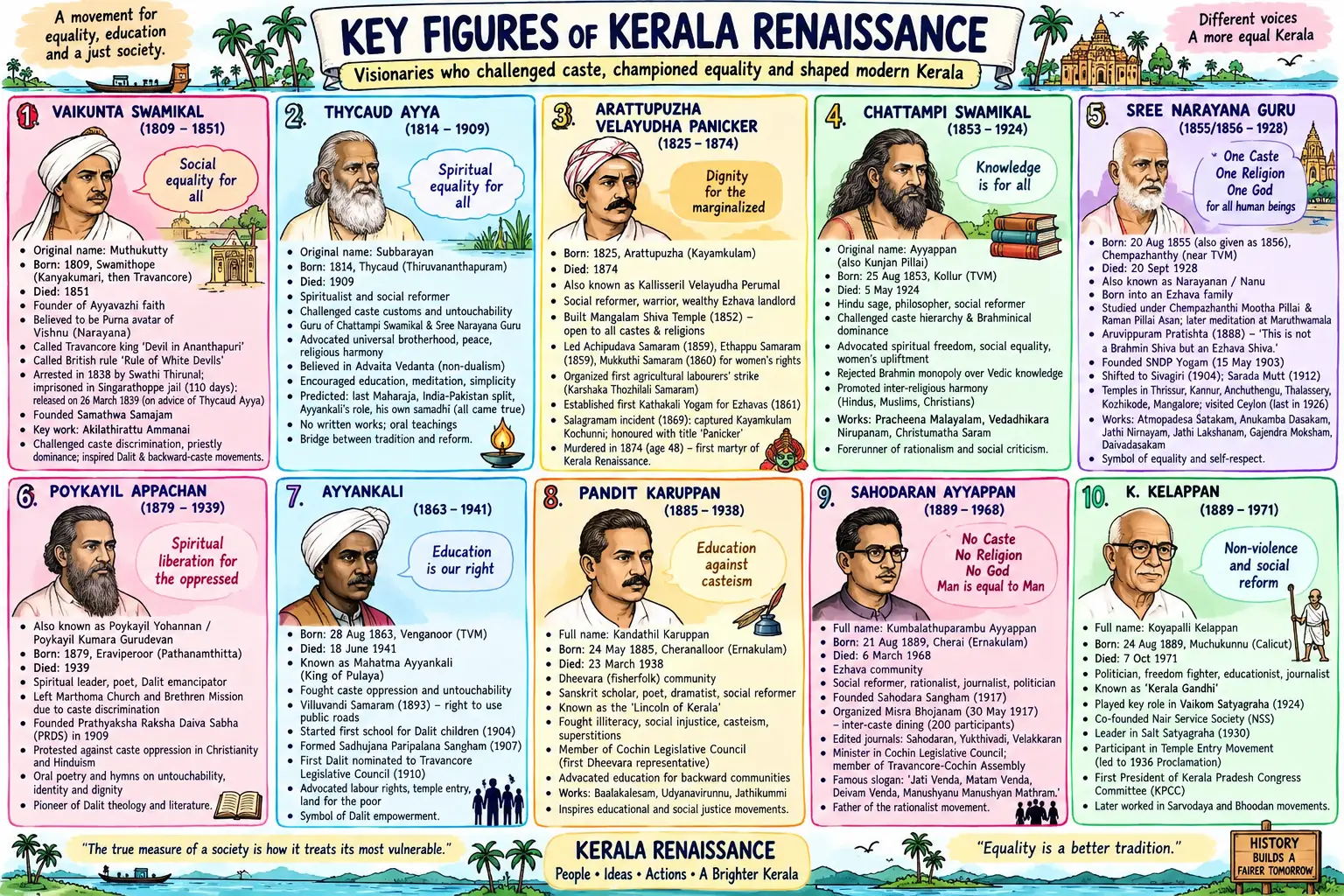
1. VAIKUNTA SWAMIKAL
Q1. Who was Vaikunta Swamikal, and what are the important facts about his early life and identity?
Answer:
- Original name: Muthukutty
- Born: 1809
- Birthplace: Swamithope, Kanyakumari district, then part of Travancore
- Died: 1851
- Also known as Ayya Vaikundar, Siva Narayana and Vaikunda Swami
- Founder of the Ayyavazhi faith
- Ayyavazhis believe him to be the first and foremost Purna avatar of Vishnu (Narayana).
- He emerged as an important early opponent of caste discrimination and social inequality.
Q2. Why was Vaikunta Swamikal arrested by the Travancore government?
Answer:
Vaikunta Swamikal made several controversial statements against the existing rulers.
- He referred to the Travancore king as the “Devil in Ananthapuri.”
- He described British rule as the “Rule of White Devils.”
- His popularity increased and large numbers of people began gathering around him.
- A complaint was lodged against him with Swathi Thirunal Rama Varma, King of Travancore.
- The king arrested Vaikundar in 1838.
- He was imprisoned in Singarathoppe jail.
- He remained imprisoned for 110 days.
- He was released on 26 March 1839.
- Swathi Thirunal released him on the advice of Thycaud Ayya.
- Thycaud Ayya was the Guru of Swathi Thirunal Maharaj and was also a disciple of Ayya Vaikundar.
Q3. What were the major contributions of Vaikunta Swamikal?
Answer:
- Founded the Ayya Vazhi movement, a monotheistic and anti-caste spiritual tradition.
- Challenged caste discrimination, particularly discrimination against the Nadar community.
- Established the Samathwa Samajam, one of the earliest social reform movements in South India.
- Advocated:
- Social equality
- Abolition of priestly dominance
- Dignity for oppressed people
Q4. What is the important work associated with Vaikunta Swamikal, and what is his present relevance?
Answer:
Important work:
- Akilathirattu Ammanai
- It is a scripture composed by his followers.
- It describes his teachings and philosophy.
Current relevance:
- Regarded as a pioneer of anti-caste movements in Kerala and Tamil Nadu.
- His teachings continue to inspire Dalit and backward-caste movements.
- Ayya Vazhi continues to be followed by thousands of people.
- He is recognized as a precursor to later reformers such as Sree Narayana Guru.
2. THYCAUD AYYA (AYYA SWAMIKAL)
Q5. Who was Thycaud Ayya?
Answer:
- Original name: Subbarayan
- Born: 1814
- Birthplace: Thycaud, Thiruvananthapuram
- Died: 1909
- Also known as Thycaud Ayyavu Swamikal / Ayyaguru Swamikal
- He was a spiritualist and social reformer.
- He was the first to challenge caste customs in Kerala during a period when caste restrictions and untouchability were at their peak.
Q6. What predictions are attributed to Thycaud Ayya?
Answer:
Thycaud Ayya was an accomplished astrologer and was believed to possess the siddhi to predict future events.
His predictions included:
- The younger Maharani’s son would become the last Maharaja.
- North India would eventually separate.
- Ayyankali would be appointed to a participative administrative body to help the downtrodden.
- He predicted the date of his own Samadhi.
According to the source, these predictions came true:
- Ayyankali was nominated to the Sri Moolam Assembly and honoured by the rulers.
- Ayyankali’s statue was later unveiled by Prime Minister Indira Gandhi.
- Maharaja Chithira Tirunal became the last King of Travancore.
- Thycaud Ayya attained Samadhi on the date he had forecast.
- India was divided into India and Pakistan about fifty years after his prediction.
Q7. What were the major contributions and teachings of Thycaud Ayya?
Answer:
- Spiritual leader and social reformer.
- Guru of Chattampi Swamikal and Sree Narayana Guru.
- Promoted:
- Universal brotherhood
- Peace
- Religious harmony
- Believed in Advaita Vedanta or non-dualism.
- Advocated spiritual equality among all people.
- Encouraged:
- Education
- Meditation
- Simplicity in life
He left no written works directly, but his oral teachings deeply influenced Kerala's reform tradition.
Q8. What is the present significance of Thycaud Ayya?
Answer:
- Remembered as a bridge between tradition and reform.
- Mentored important Kerala Renaissance leaders.
- Represents a non-violent and spiritual approach to social change.
- Statues and memorials have been established in his honour, particularly in Thiruvananthapuram.
3. ARATTUPUZHA VELAYUDHA PANICKER
Q9. Who was Arattupuzha Velayudha Panicker?
Answer:
- Born: 1825
- Birthplace: Arattupuzha, Kayamkulam
- Died: 1874
- Also known as Kallisseril Velayudha Perumal
- He was a 19th-century social reformer and warrior.
- He fought against several social evils prevalent in Kerala.
- He was a wealthy Ezhava landlord who used his resources to uplift marginalized communities.
Q10. What was the importance of the temple constructed by Velayudha Panicker?
Answer:
- He built the Mangalam Shiva Temple, also known as the Edakkad Jnaneswara Temple, at Arattupuzha.
- It was built in 1852.
- The temple was opened to people of all castes and religions.
- He challenged caste restrictions concerning temple entry.
- He also challenged discriminatory dress codes.
- He constructed temples such as the Mangalam Temple at Kayamkulam, where lower castes could worship freely.
Q11. What major social struggles were led by Arattupuzha Velayudha Panicker?
Answer:
He organized several important struggles for the rights and dignity of marginalized communities:
Achipudava Samaram – 1859
- Conducted at Kayamkulam.
- A struggle for the right of women of backward communities to wear a lengthy lower garment extending below the knees.
Karshaka Thozhilali Samaram
- Organized by Velayudha Panicker.
- Described in the source as the first-ever strike by agricultural labourers in Kerala.
- The strike succeeded.
Ethappu Samaram – 1859
- A continuation of the Achipudava Samaram.
- Fought for the right of women of backward communities to wear upper cloth.
Mukkuthi Samaram – 1860
- Led at Pandalam.
- Fought for the right of women belonging to marginalized communities to wear nose studs and other gold ornaments.
These successful struggles played an important role in increasing the dignity of marginalized women.
Q12. What was Velayudha Panicker's contribution to Kathakali?
Answer:
- In 1861, he established the first Kathakali Yogam for Ezhavas.
- Kathakali performed by Ezhavas and members of other backward communities was staged for the first time.
Q13. What was the Salagramam incident associated with Velayudha Panicker?
Answer:
- In 1869, Brahmin priest Tharananellur Nambudiri was travelling to the Padmanabhaswamy Temple for Murajapam.
- Murajapam involved the chanting of prayers and recitation of three Vedas for 56 days.
- His Salagramam, a sacred stone, was robbed in the backwaters of Kayamkulam.
- Kayamkulam Kochunni had stolen it.
- Palace and police officials failed to find him.
- Velayudha Panicker was then entrusted with the task.
- He captured Kayamkulam Kochunni and submitted him to the Diwan.
- The Salagramam was recovered and returned to Tharananellur Nambudiri.
- Panicker was honoured by the King.
- Velayudha Chekavar was given the title “Panicker” by the King of Travancore.
Q14. How did Arattupuzha Velayudha Panicker die, and why is his death significant?
Answer:
- In 1874, some upper-caste men plotted against him.
- He was murdered while sleeping during a boat journey at night.
- They obtained the help of a converted Ezhava Muslim named Thoppiyitta Kittan.
- Velayudha Panicker was 48 years old at the time of his death.
- He is described as the first martyr of the Kerala Renaissance.
- He had defied Nair and Namboothiri dominance and organized armed resistance when necessary.
- He was assassinated by upper-caste opponents who feared his increasing influence.
Current relevance:
- Recognized as one of the earliest martyrs of Kerala's social reform movement.
- His legacy is celebrated through books, plays and public commemorations.
- Seen as a symbol of courage and resistance to caste oppression.
4. CHATTAMPI SWAMIKAL
Q15. Who was Chattampi Swamikal?
Answer:
- Original name: Ayyappan
- Also known as Kunjan Pillai
- Born: 25 August 1853
- Birthplace: Kollur, Thiruvananthapuram
- Died: 5 May 1924
- Ayyappan Pillai, better known as Chattampi Swamikal, was a Hindu sage and social reformer.
- His ideas influenced many social, religious, literary and political organizations and movements in Kerala.
- His work gave a voice to marginalized people.
Q16. What were the major ideas and contributions of Chattampi Swamikal?
Answer:
- Philosopher, yogi and social reformer.
- Challenged:
- Caste hierarchy
- Brahminical dominance
- Advocated:
- Spiritual freedom
- Social equality
- Upliftment of women
- Upliftment of marginalized communities
- Rejected the idea that only Brahmins had access to Vedic knowledge.
- Promoted inter-religious harmony among:
- Hindus
- Muslims
- Christians
Q17. What are the important works of Chattampi Swamikal?
Answer:
- Pracheena Malayalam – debunked caste myths and argued that all people had equal access to knowledge.
- Vedadhikara Nirupanam – argued for the right of non-Brahmins to study the Vedas.
- Christumatha Saram – expressed respect for all religions and emphasized unity.
Current relevance:
- Regarded as a forerunner of rationalism and social criticism in Kerala.
- His teachings continue to influence social thinkers, reformers and spiritual seekers.
5. SREE NARAYANA GURU
Q18. Who was Sree Narayana Guru, and what does the source state about his birth and family?
Answer:
The introductory details give:
- Born: 20 August 1855
- Birthplace: Chempazhanthy, near Thiruvananthapuram
- Died: 20 September 1928
The later biographical section gives his birth as 20 August 1856.
- Also known as Narayanan / Nanu
- Father: Madan Asan
- Mother: Kuttiyamma
- Born into an Ezhava family of Ayurvedic physicians.
- Birthplace: Chempazhanthy near Thiruvananthapuram in the erstwhile state of Travancore.
He became a philosopher, spiritual leader and social reformer who led a movement against injustice in Kerala's caste-ridden society.
Q19. What was Narayana Guru's famous philosophy, and what was Daiva Dasakam?
Answer:
His famous statement was:
“One Caste, One Religion, One God for all human beings.”
The source also gives the form:
“One Caste, One Religion, One God for Man.”
His goals included:
- Spiritual enlightenment
- Social equality
- Equality across caste divisions
He wrote the Advaita poem Daiva Dasakam, one of the most widely used poems in Kerala for community prayer.
Q20. What education and spiritual training did Narayana Guru receive?
Answer:
- Unlike other Ezhavas who generally confined Sanskrit reading to Ayurvedic works, Narayana Guru studied religious texts.
- His early education followed the Gurukula system under Chempazhanthi Mootha Pillai.
- His mother died when he was 15.
- At 21, he went to Central Travancore.
- He studied under Sanskrit scholar Raman Pillai Asan.
- Raman Pillai Asan taught him:
- Vedas
- Upanishads
- Sanskrit literature
- Logical rhetoric
Q21. What happened during Narayana Guru's early adult life before he became a major reformer?
Answer:
- A year after going to study under Raman Pillai Asan, he married Kaliamma.
- He soon disassociated himself from the marriage to begin his public life as a social reformer.
- He returned to his village in 1881 when his father became seriously ill.
- He started a village school and taught local children.
- This earned him the name Nanu Asan.
- He later travelled through Kerala and Tamil Nadu.
- During these travels, he met Chattampi Swamikal.
- Chattampi Swamikal introduced him to Ayyavu Swamikal.
- From Ayyavu Swamikal, Guru learned meditation and yoga.
- He eventually reached the Pillathadam cave at Maruthwamala.
- He established a hermitage there.
- He practised meditation there for the next eight years.
Q22. What was the Aruvippuram Pratishta, and why was it significant?
Answer:
- In 1888, Narayana Guru visited Aruvippuram.
- He meditated in a cave near the Neyyar River.
- His first and one of his prominent disciples, Sivalingadasa Swamikal, discovered him there.
- Sivalingadasa Swamikal belonged to an orthodox Nair family.
- Guru took a rock from the deepest part of the Neyyar River.
- The place was a whirlpool sinkhole called Sankaran Kuzhi.
- It is believed that sage Agastya had given his worshipping Shiva Linga to the Neyyar River at Sankaran Kuzhi before leaving.
- Guru consecrated the rock as an idol of Shiva.
- The site became known as the Aruvippuram Shiva Temple.
The consecration became known as the Aruvippuram Pratishta.
Upper-caste Brahmins questioned Guru's right to consecrate the idol.
His famous reply was:
“This is not a Brahmin Shiva but an Ezhava Shiva.”
The statement later became a famous anti-caste quotation.
Q23. How was the SNDP Yogam established?
Answer:
- The Sree Narayana Dharma Paripalana Yogam (SNDP Yogam) was founded at Aruvippuram.
- Date: 15 May 1903
- It was established through the efforts of Padmanabhan Palpu.
- Narayana Guru became its founder president.
- It organized social reform activities.
Q24. What educational and temple-building activities did Narayana Guru undertake?
Answer:
- In 1904, Guru shifted his base to Sivagiri near Varkala.
- He opened a school for children belonging to the lower sections of society.
- The school provided free education irrespective of caste.
- It took seven years to construct a temple there.
- Sarada Mutt was built in 1912.
He also constructed temples in:
- Thrissur
- Kannur
- Anchuthengu
- Thalassery
- Kozhikode
- Mangalore
He travelled widely, including to Sri Lanka, then called Ceylon.
- His final visit to Ceylon was in 1926.
Q25. What were the circumstances surrounding Narayana Guru's final days?
Answer:
- His last public function was a meeting at Pallathuruthy.
- He became ill soon afterwards.
- He received treatment at:
- Aluva
- Thrissur
- Palakkad
- Chennai
Ayurvedic physicians who treated him included:
- Cholayil Mami Vaidyar
- Panappally Krishnan Vaidyar
- Thycauttu Divakaran Moos
Allopathic physicians included:
- Krishnan Thampi
- Panikker
- Palpu
- A European physician named Noble
He returned to Sarada Mutt and died on 20 September 1928, aged 72.
Q26. What are the important works and continuing significance of Sree Narayana Guru?
Answer:
Important works include:
- Atmopadesa Śatakam – 100 verses on self-realization
- Anukamba Dasakam
- Jathi Nirnayam
- Jathi Lakshanam
- Gajendra Moksham Vanchipattu
- Daivadasakam
He wrote numerous poems and philosophical works promoting:
- Equality
- Self-respect
- Spiritual unity
Current relevance:
- Continues to inspire social justice movements.
- Influences secular thought and educational initiatives.
- His birthday is celebrated as Sree Narayana Guru Jayanti, a public holiday in Kerala.
6. POYKAYIL APPACHAN (POYKAYIL YOHANNAN)
Q27. Who was Poykayil Appachan?
Answer:
- Also known as Poykayil Yohannan
- Also known as Poykayil Kumara Gurudevan
- Born: 1879
- Birthplace: Eraviperoor, Pathanamthitta district
- Died: 1939
- Spiritual leader
- Poet
- Dalit emancipator
- Renaissance leader
- Founder of the Prathyaksha Raksha Daiva Sabha (PRDS), meaning “God's Society of Obvious Salvation.”
PRDS was a socio-religious movement dedicated to the spiritual liberation and social upliftment of Kerala's oppressed castes.
Q28. Why did Poykayil Yohannan leave Christianity and establish the PRDS?
Answer:
- Yohannan joined the Marthoma Church, a reformist sect among Syrian Christians.
- He realized that Dalits were treated as an inferior class and left it.
- He then joined the Brethren Mission.
- He experienced similar caste discrimination there.
- He concluded that Indian Christian communities continued to practise caste discrimination.
- He believed this violated the fundamental principles of Christianity.
In 1909:
- Yohannan left Christianity.
- He established his own religious protest movement, the Prathyaksha Raksha Daiva Sabha.
- Afterwards, he became known as Poikayil Appachan or Kumara Gurudevan.
- He advocated spiritual liberation.
- He sought to empower and consolidate Dalits.
- He promoted a creed in which Dalit castes would be free from discrimination.
Q29. What were Poykayil Appachan's major contributions and literary significance?
Answer:
- Protested against caste oppression within both Christianity and Hinduism.
- Founded PRDS in 1909 to liberate Dalits from caste-based slavery.
- Spoke for the cultural and historical rights of Dalits.
- Argued that Dalit stories had been erased from official religion and history.
- His oral poetry and hymns described:
- Pain of untouchability
- Search for identity
- Search for dignity
- His works were preserved in the PRDS tradition, though he did not formally compile them.
Current relevance:
- Considered a pioneer of Dalit theology and literature in Kerala.
- Increasingly recognized in academic and literary circles as a voice of subaltern history.
7. AYYANKALI
Q30. Who was Ayyankali, and what social conditions influenced his work?
Answer:
- Born: 28 August 1863
- Birthplace: Venganoor, Thiruvananthapuram
- Died: 18 June 1941
- Known as Mahatma Ayyankali
- Social reformer
- Educator
- Economist
- Lawmaker
- Revolutionary leader
- Known as the “King of Pulaya.”
He worked for oppressed people in the princely state of Travancore.
During his lifetime, the region was deeply divided by caste and was described as a “mad house” of castes.
- Pulayars were regarded as slaves of the agrarian society.
- They faced severe discrimination, particularly from landowning castes including the Nair caste.
Q31. How did Ayyankali initially respond to caste oppression?
Answer:
- Social injustice led him to join his Pulayar friends after their workday.
- They sang and danced to folk music protesting their conditions.
- Some joined him in forming a group that challenged members of oppressive castes.
- These confrontations sometimes resulted in physical fights.
- His popularity earned him the names:
- Urpillai
- Moothapullai
- These roughly mean “Leader of the Land” or “Elder Leader.”
Personal life:
- Married Chellamma in 1888.
- They had seven children.
Q32. What were Ayyankali's major struggles for Dalit rights?
Answer:
- Fought against:
- Caste oppression
- Untouchability
- Denial of education to lower castes
Villuvandi Samaram – 1893
- Ayyankali rode a bullock cart or Villuvandi on a public road.
- This openly defied caste laws restricting Dalits from using public roads.
Education – 1904
- Started the first school for Dalit children in Kerala.
- This resulted in backlash from upper castes.
Sadhujana Paripalana Sangham – 1907
- Established to organize and lead Dalits in their struggle for rights.
Q33. What was Ayyankali's role in politics and labour reform?
Answer:
- Became the first Dalit nominated to the Travancore Legislative Council in 1910.
- Advocated:
- Labour rights
- Temple entry
- Land for the poor
Current relevance:
- Symbol of resistance and pioneer of Dalit empowerment in Kerala.
- Remembered annually through tributes.
- His work helped pave the way for the Temple Entry Proclamation of 1936.
8. PANDIT KARUPPAN
Q34. Who was Pandit Karuppan?
Answer:
- Full name: Kandathil Karuppan
- Born: 24 May 1885
- Birthplace: Cheranalloor, Ernakulam
- Died: 23 March 1938
- Community: Dheevara, a fisherfolk caste
- Sanskrit scholar
- Poet
- Dramatist
- Social reformer
He emerged from Ernakulam in Cochin State and became a major crusader against untouchability and social evils.
He was called the “Lincoln of Kerala” for helping socio-economically and educationally backward communities advance.
Q35. What social issues did Pandit Karuppan campaign against?
Answer:
He belonged to a community of inland fishermen engaged in localized fishing in backwaters and rivers.
As the first human rights activist of Cochin State, he used his literary and organizational abilities to combat:
- Illiteracy
- Social injustice
- Casteism
- Superstitions
He also campaigned for the empowerment of the Dheevara community.
Q36. What were Pandit Karuppan's major political, educational and literary contributions?
Answer:
- Worked for upliftment of backward communities, especially fishing communities.
- Fought for:
- Education
- Dignity
- Representation of backward castes
- Became a member of the Cochin Legislative Council.
- Became the first Dheevara caste representative in the Council.
- Advocated establishment of schools and libraries for marginalized communities.
Important works:
- Baalakalesam
- Udyanavirunnu
- Jathikummi
His poems criticized caste discrimination and demanded social change.
His writing combined literary excellence with reformist ideals.
Current relevance:
- Honoured as the “Lincoln of Kerala” for his oratory and reforms.
- Continues to inspire educational and social justice movements, particularly in coastal communities.
9. SAHODARAN AYYAPPAN
Q37. Who was Sahodaran Ayyappan?
Answer:
- Full name: Kumbalathuparambu Ayyappan
- Born: 21 August 1889
- Birthplace: Cherai, Ernakulam
- Died: 6 March 1968
- Community: Ezhava
- Social reformer
- Thinker
- Rationalist
- Journalist
- Politician
- Vocal follower of Sree Narayana Guru
He founded:
- Sahodara Sangam/Sahodara Sangham
- Journal Sahodaran
He was also the founder editor of Yukthivadi.
Q38. What was Misra Bhojanam, and how did it lead to Ayyappan being called Sahodaran Ayyappan?
Answer:
After graduation, Ayyappan returned from Thiruvananthapuram to Cherai in 1917.
He founded the Sahodara Sangham or Brotherhood Association to fight the caste system.
Under its leadership:
- He organized Misra Bhojanam, an inter-caste feast.
- Date: 30 May 1917
- Venue: House of his nephew Raman Pillai
- People of all castes sat and ate under one roof.
- Around 200 people participated.
- Participants included members of the Pulaya caste, who were regarded as untouchable.
- The conservative Ezhava community opposed the event.
His opponents called him “Pulaya Ayyappan” as a derogatory name.
- Ayyappan accepted the name as a decoration.
The establishment of the Sahodara Sangham also gave him the name “Sahodaran Ayyappan,” by which he became widely known.
Q39. What were Sahodaran Ayyappan's major contributions, publications and political roles?
Answer:
- Promoted:
- Inter-caste equality
- Scientific temper
- Secularism
- Was a disciple of Sree Narayana Guru.
- Later expanded Guru's ideas through a stronger rationalist approach.
- Founded Sahodara Sangham in 1917.
- Organized Misra Bhojanam.
Edited journals including:
- Sahodaran
- Yukthivadi
- Velakkaran
These publications promoted:
- Atheism
- Science
- Anti-caste ideology
Political roles:
- Served as a minister in the Cochin Legislative Council.
- Later served in the Travancore-Cochin Assembly.
Q40. What famous slogan was coined by Sahodaran Ayyappan?
Answer:
He coined:
“Jati Venda, Matam Venda, Deivam Venda, Manushyanu Manushyan Mathram.”
Meaning:
“No Caste, No Religion, No God, Man is Equal to Man.”
Current relevance:
- Regarded as the father of the rationalist movement in Kerala.
- His ideas contributed to the development of:
- Progressive thought
- Secularism
- Leftist politics in Kerala
10. K. KELAPPAN
Q41. Who was K. Kelappan?
Answer:
- Full name: Koyapalli Kelappan
- Born: 24 August 1889
- Birthplace: Muchukunnu, Calicut
- Died: 7 October 1971
- Politician
- Independence activist
- Educationist
- Journalist
- Leading figure of the Indian National Congress in Kerala
- Popularly known as “Kerala Gandhi.”
After independence, he held positions in various Gandhian organizations.
He was:
- Co-founder and first president of the Nair Service Society
- Founder of the Kerala Kshetra Samrakshana Samiti or Temple Protection Movement
Q42. What were K. Kelappan's major contributions to social reform and the freedom struggle?
Answer:
- Known as Kerala Gandhi for his commitment to non-violence and social reform.
- Played an important role in the Vaikom Satyagraha of 1924, which opposed caste-based restrictions on roads near temples.
- Co-founded the Nair Service Society (NSS).
- Later concentrated on inter-caste unity and social reform.
- Became one of the leaders of the Salt Satyagraha in Kerala in 1930.
- Participated in the Temple Entry Movement.
- The movement eventually led to the Temple Entry Proclamation of 1936.
- Became the first President of the Kerala Pradesh Congress Committee (KPCC).
Q43. What did K. Kelappan do after independence?
Answer:
- Worked with the Sarvodaya movement.
- Worked with the Bhoodan movement.
- Promoted:
- Gandhian principles
- Rural upliftment
He is remembered as both a freedom fighter and social reformer, and his values continue to influence Gandhian institutions and education policies in Kerala.
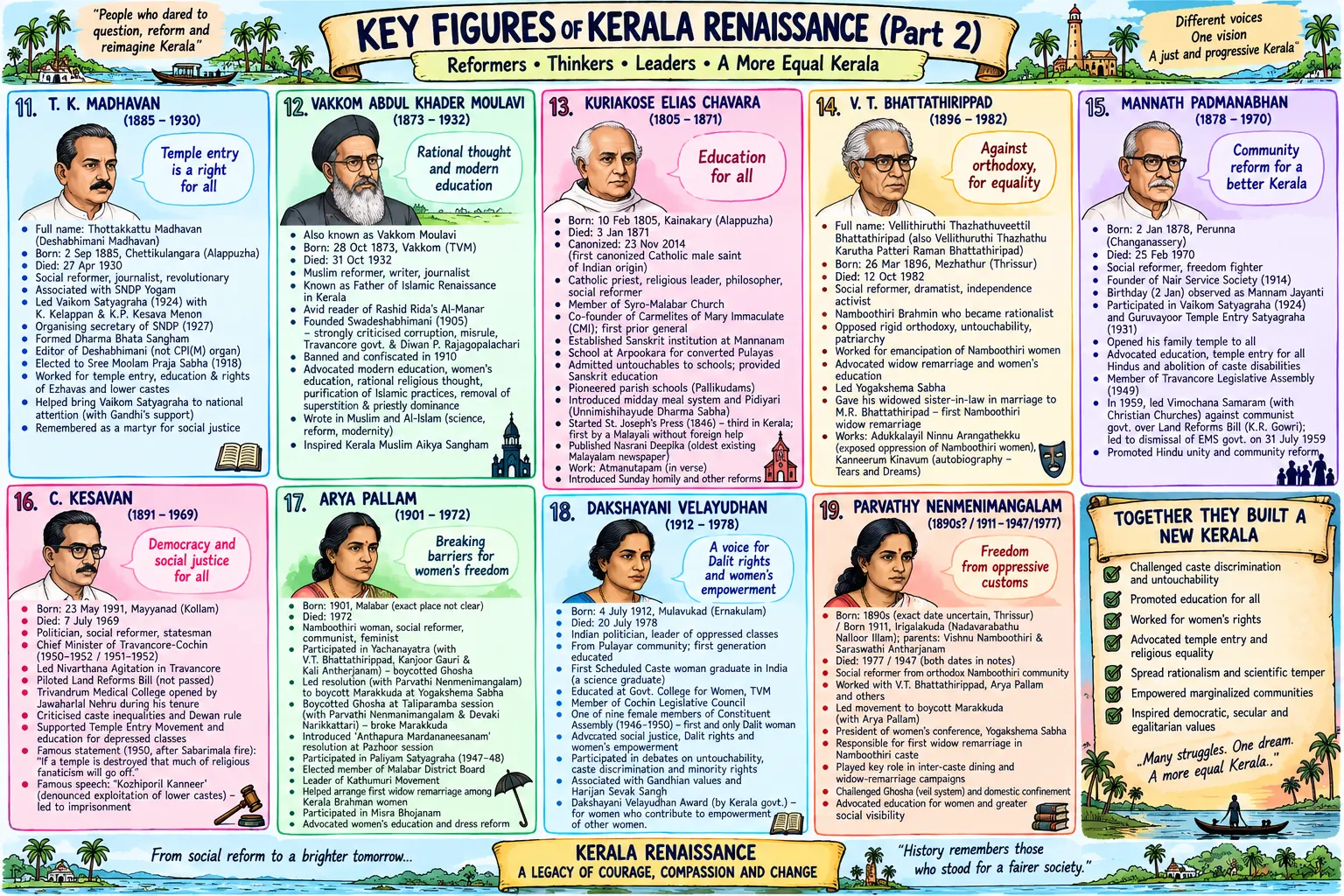
11. T.K. MADHAVAN
Q44. Who was T.K. Madhavan?
Answer:
- Full name: Thottakkattu Madhavan
- Also known as Deshabhimani Madhavan
- Born: 2 September 1885
- Birthplace: Chettikulangara, Alappuzha
- Died: 27 April 1930
- Social reformer
- Journalist
- Revolutionary
- Associated with the Sree Narayana Dharma Paripalana Yogam (SNDP Yogam).
- Led struggles against social discrimination, including the Vaikom Satyagraha.
Q45. What was T.K. Madhavan's role in the Vaikom Satyagraha?
Answer:
The Vaikom Satyagraha began in 1924 under the leadership of:
- T.K. Madhavan
- K. Kelappan
- K.P. Kesava Menon
Its objective was to secure the right of oppressed people to travel through the road in front of the Vaikom Sree Mahadeva Temple.
- Madhavan and Kesava Menon were arrested and imprisoned.
- Eventually, the Maharaja of Travancore agreed to open the road to people of all classes.
- The Vaikom Satyagraha was successful.
- However, Madhavan had to continue the struggle for temple entry.
Q46. What were T.K. Madhavan's other organizational, journalistic and political contributions?
Answer:
- In 1927, he became the organizing secretary of SNDP Yogam.
- Formed the voluntary organization Dharma Bhata Sangham to strengthen SNDP activities.
- Worked for the rights of:
- Ezhava community
- Lower castes
- Served as editor of Deshabhimani newspaper, which the source specifically notes was not the CPI(M) organ.
- Used the newspaper to raise social justice issues.
- Helped bring the Vaikom Satyagraha to national attention by convincing Mahatma Gandhi to support it.
- Led the Temple Entry Movement.
- Advocated the right of all castes to enter temples.
- Elected to the Sree Moolam Praja Sabha in 1918.
- Used his position to campaign for educational and social rights.
Current relevance:
- Pioneer of temple-entry and civil-rights movements in Kerala.
- Commemorated in Kerala's public memory as a martyr for social justice.
12. VAKKOM ABDUL KHADER MOULAVI
Q47. Who was Vakkom Abdul Khader Moulavi?
Answer:
- Also known as Vakkom Moulavi
- Born: 28 October 1873
- Birthplace: Vakkom, Thiruvananthapuram
- Died: 31 October 1932
- Muslim reformer
- Writer
- Journalist
- Known as the Father of Islamic Renaissance / Father of Muslim Renaissance in Kerala.
- An avid reader of Rashid Rida's Islamic magazine Al-Manar.
Q48. What was the importance of Swadeshabhimani newspaper?
Answer:
- Vakkom Moulavi founded Swadeshabhimani newspaper in 1905.
- He was its founder and publisher.
- It strongly criticized:
- Corruption
- Misrule
- Travancore government
- Diwan of Travancore P. Rajagopalachari
- The newspaper was banned and confiscated by the Government of Travancore in 1910.
Q49. What reforms did Vakkom Moulavi advocate?
Answer:
He advocated among Kerala Muslims for:
- Modern education
- Women's education
- Rational religious thought
- Purification of Islamic practices
- Removal of superstition
- Removal of priestly dominance
He also influenced the formation of a Mappila Muslim identity based on education and reform.
Important writings:
- Translations and writings about Islam in Malayalam.
- Articles on:
- Science
- Reform
- Modernity
He wrote in journals such as:
- Muslim
- Al-Islam
Current relevance:
- Considered a visionary Islamic modernist.
- Inspired later Muslim reformers and institutions including the Kerala Muslim Aikya Sangham.
13. KURIAKOSE ELIAS CHAVARA
Q50. Who was Kuriakose Elias Chavara?
Answer:
- Born: 10 February 1805
- Birthplace: Kainakary, Alappuzha
- Died: 3 January 1871
- Canonized: 23 November 2014
- Canonized as a Saint by the Catholic Church.
- Catholic priest
- Religious leader
- Philosopher
- Social reformer
- Member of the Syro-Malabar Church
- First canonized Catholic male saint of Indian origin.
He was:
- Co-founder of the Carmelites of Mary Immaculate (CMI)
- First prior general of the first congregation for men in the Syro-Malabar Church.
Q51. What did Kuriakose Elias Chavara do to expand education among marginalized communities?
Answer:
- Established an institution for Sanskrit studies at Mannanam.
- A tutor belonging to the Variar community was brought from Thrissur to teach there.
- Later established a school at Arpookara for the converted Pulaya community.
- He admitted untouchables to schools.
- He also provided them Sanskrit education, which had been forbidden to lower castes.
- Through this, he challenged caste-based social restrictions in the early part of the 19th century.
- He pioneered parish-based schools in Kerala, commonly known as Pallikudams/Pallikkoodams.
- Promoted education for:
- Girls
- Lower castes
The source describes the Pallikkoodam system attached to every church as the first initiative for universal education.
Q52. How was Kuriakose Chavara associated with the midday meal system and Pidiyari?
Answer:
Chavara believed that the schools at Mannanam and Arpookara would succeed only if poor students, particularly Dalits, were provided with midday meals.
- The source describes this as his original idea.
- It later inspired Sir C. P. Ramaswamy Iyer to recommend the system to the King for implementation in government schools.
Chavara also started the charity practice called Pidiyari, meaning a handful of rice.
Under this system:
- People set aside a small quantity of rice every day.
- It was stored in a special collection pot.
- The collected rice was taken to church during weekends.
- It was used to feed poor people, especially students through midday meals.
He established the organization:
“Unnimishihayude Dharma Sabha”
It managed the Pidiyari collection.
Q53. What was Chavara's contribution to printing and Malayalam journalism?
Answer:
- Started St. Joseph's Press at Mannanam in 1846.
- It was the third printing press in Kerala.
- It was the first press founded by a Malayali without foreign assistance.
- The oldest existing Malayalam newspaper still in circulation, Nasrani Deepika, came from this printing press.
- Chavara also established printing presses and published Malayalam literary and devotional works.
Q54. What are the important work and other innovations associated with Kuriakose Elias Chavara?
Answer:
Important work:
- Atmanutapam – a spiritual autobiography written in verse.
Other contributions:
- Introduced the Sunday homily.
- Introduced other liturgical and social innovations.
Current relevance:
- Revered as a pioneer of modern education and social upliftment in Kerala.
- His institutions continue to be influential, including:
- CMI schools
- Seminaries
- Printing presses
14. V.T. BHATTATHIRIPPAD
Q55. Who was V.T. Bhattathirippad?
Answer:
- Full name given: Vellithiruthi Thazhathuveettil Bhattathiripad
- The biographical section also gives the name Vellithuruthi Thazhathu Karutha Patteri Raman Bhattathiripad.
- Born: 26 March 1896
- Birthplace: Mezhathur, Thrissur
- Died: 12 October 1982
- Social reformer
- Dramatist
- Indian independence activist
- Namboothiri Brahmin who became a revolutionary reformer and rationalist.
He is particularly known for reforming the casteism and conservatism of the Namboothiri community.
Q56. What social reforms did V.T. Bhattathirippad advocate?
Answer:
- Opposed:
- Rigid Brahmin orthodoxy
- Untouchability
- Patriarchy
- Worked for the emancipation of Namboothiri women.
- Advocated:
- Widow remarriage
- Women's education
- Led the Yogakshema Sabha, which sought to reform the Namboothiri community.
He and M.R. Bhattathiripad (MRB) campaigned for widow remarriage by putting the principle into practice.
- V.T. gave his widowed sister-in-law in marriage to MRB.
- The source describes it as the first widow remarriage among Namboothiris in Kerala.
Q57. What are the important literary works of V.T. Bhattathirippad?
Answer:
Adukkalayil Ninnu Arangathekku – “From the Kitchen to the Stage”
- Historic play.
- Exposed the oppression faced by Namboothiri women.
Kanneerum Kinavum
- His autobiography.
- A significant literary and reformist work.
- The source also refers to it as “Tears and Dreams” in English.
These works are considered notable contributions to Malayalam literature.
15. MANNATH PADMANABHAN
Q58. Who was Mannath Padmanabhan?
Answer:
- Born: 2 January 1878
- Birthplace: Perunna, Changanassery
- Died: 25 February 1970
- Social reformer
- Freedom fighter
- Founder of the Nair Service Society (NSS).
- NSS represents the Nair community.
- His birthday, 2 January, is observed annually as Mannam Jayanti.
- He is regarded as a visionary reformer who organized the Nair community through the NSS.
Q59. What was Mannath Padmanabhan's role in anti-caste and temple-entry struggles?
Answer:
He fought for social equality.
- Participated in the Vaikom Satyagraha of 1924.
- It demanded that public roads near the Vaikom temple be opened to lower-caste Hindus.
- Participated in the Guruvayoor Temple Entry Satyagraha of 1931.
- Both were anti-untouchability struggles.
- He opened his family temple to everyone irrespective of caste.
- Advocated:
- Education
- Temple entry for all Hindus
- Abolition of caste disabilities
He also participated in the Indian independence movement, mainly through a social reformist platform.
Q60. What was Mannath Padmanabhan's political role and involvement in the Vimochana Samaram?
Answer:
- Became a member of the Travancore Legislative Assembly in 1949.
- Promoted Hindu unity while working for community-based reform.
In 1959:
- Padmanabhan and Christian Churches led a united opposition to the State Communist Ministry.
- This became known as the Vimochana Samaram or Liberation Struggle.
- According to the source, its cause was the introduction of the Land Reforms Bill by Minister K.R. Gowri.
- The movement resulted in the dismissal of the Communist government led by E.M.S. Namboodiripad.
- Date of dismissal: 31 July 1959.
Other key fact:
- Founder of the Nair Service Society in 1914.
16. C. KESAVAN
Q61. Who was C. Kesavan?
Answer:
- Full name: C. Kesavan
- Born: 23 May 1891
- Birthplace: Mayyanad, Kollam
- Died: 7 July 1969
- Politician
- Social reformer
- Statesman
- Freedom fighter
- Chief Minister of Travancore-Cochin
The introductory section gives his tenure as 1950–1952, while the major-contributions section gives 1951–1952.
Q62. What were C. Kesavan's important political and reform activities?
Answer:
- Led the Nivarthana Agitation in Travancore.
- Its aim was to secure democratic authority for citizens in deciding legislation.
- It also sought opportunities irrespective of:
- Caste
- Social status
- Economic status
- Piloted the historic Land Reforms Bill, but it failed to pass.
- Trivandrum Medical College was opened by Prime Minister Jawaharlal Nehru during Kesavan's tenure.
- Criticized:
- Caste-based inequalities
- Dewan rule in Travancore
- Supported:
- Temple Entry Movement
- Education for depressed classes
Q63. What controversial statement and famous speech are associated with C. Kesavan?
Answer:
A fire broke out at Sabarimala in May 1950.
In the following months, before becoming Travancore-Cochin Chief Minister, Kesavan stated:
“If a temple is destroyed that much of religious fanaticism will go off.”
His famous speech:
“Kozhiporil Kanneer”
- Denounced the exploitation of lower castes.
- The speech led to his imprisonment.
17. ARYA PALLAM
Q64. Who was Arya Pallam?
Answer:
- Born: 1901
- Birthplace: Malabar region
- Exact place is not clearly documented in the source.
- Died: 1972
- Namboothiri woman
- Social reformer
- Communist
- Feminist
- Fought against the oppression of upper-class/Brahmin women.
- Boldly challenged patriarchal oppression within the Brahmin community.
Q65. What was Arya Pallam's role in the Yachanayatra and campaigns against Ghosha and Marakkuda?
Answer:
Arya Pallam participated in the Yachanayatra or Begging March led by V.T. Bhattathirippad along with:
- Kanjoor Gauri Antherjanam
- Kanjoor Kali Antherjanam
The march encouraged Brahmin women to boycott their veil or Ghosha.
At a meeting of the Yogakshema Sabha held at V.T. Bhattathirippad's house:
- Arya Pallam and Parvathi Nenmenimangalam led a resolution to boycott cadjan umbrellas or Marakkuda.
- Marakkuda was considered a symbol of chastity among Brahmin women.
- They conducted a procession without Marakkuda.
At the Taliparamba session:
- Parvathi Nenmanimangalam
- Arya Pallam
- Devaki Narikkattari
boycotted Ghosha and declared that chastity did not lie in the Marakkuda.
- They broke the Marakkuda.
- They also began wearing saris like other Indian women.
Q66. What was the Anthapura Mardananeesanam resolution, and what other movements involved Arya Pallam?
Answer:
At the Pazhoor session of the Yogakshema Sabha:
- The session was presided over by K.N. Kuttan Namboodiri.
- Arya introduced a resolution called “Anthapura Mardananeesanam.”
- It literally means “Stopping of oppressions inside the house.”
She also participated in the Paliyam Satyagraha of 1947–48, along with:
- P. Priyadatta
- E.S. Saraswati
- I.C. Priyadatta
- Rema Thampuratti
- Indhira Thampuratti
Q67. What were Arya Pallam's other political and social contributions?
Answer:
- Elected member of the Malabar District Board.
- Leader of the Kathumuri Movement.
- Played an important role in arranging the first widow remarriage among Kerala Brahman and Savarna women.
- M.R. Bhattathiripad and his wife stayed with the Pallam family for some time after their marriage.
- Active in the Yogakshema Sabha.
- One of the early women involved in widow-remarriage advocacy in her community.
- Participated in Misra Bhojanam or inter-caste dining programmes.
- Advocated:
- Women's education
- Dress reform
- Freedom from domestic confinement
18. DAKSHAYANI VELAYUDHAN
Q68. Who was Dakshayani Velayudhan?
Answer:
- Born: 4 July 1912
- Birthplace: Mulavukad, Ernakulam
- Died: 20 July 1978
- Indian politician
- Leader of oppressed classes
- Belonged to the Pulayar community
- Belonged to the first generation of educated people from her community.
Q69. What important distinctions are associated with Dakshayani Velayudhan?
Answer:
The source associates several distinctions with her:
- First woman from her community to wear an upper cloth.
- However, the source itself immediately states that it is not correct to say she was one of the first women from her community to wear an upper cloth.
- First Scheduled Caste woman graduate in India.
- A science graduate.
- Member of the Cochin Legislative Council.
- One of nine female members of the Constituent Assembly of India.
The major-contributions section further identifies her as:
- First and only Dalit woman member of the Constituent Assembly of India, 1946–1950.
- One of the earliest Dalit graduates in Kerala.
- Educated at Government College for Women, Thiruvananthapuram.
Q70. What were Dakshayani Velayudhan's contributions to social justice and constitution-making?
Answer:
She was a strong advocate of:
- Social justice
- Dalit rights
- Women's empowerment
During the framing of the Indian Constitution, she actively participated in debates concerning:
- Untouchability
- Caste discrimination
- Minority rights
She was associated with Gandhian values and worked in the Harijan Sevak Sangh.
Q71. What award has the Kerala government established in honour of Dakshayani Velayudhan?
Answer:
The Kerala government constituted the:
Dakshayani Velayudhan Award
- It honours Dakshayani Velayudhan.
- The source describes her in this context as the first and only Dalit woman MLA.
- The award is given to women who have contributed to the empowerment of other women in Kerala.
19. PARVATHY NENMENIMANGALAM
Q72. Who was Parvathy Nenmenimangalam?
Answer:
The source provides differing biographical details.
At the beginning of the section, it gives:
- Born: 1890s
- Exact date uncertain
- Birthplace: Thrissur district
- Died: 1977
The subsequent biographical paragraph states:
- Born in 1911
- Parents: Vishnu Namboothiri and Saraswathi Antharjanam
- Birthplace: Irigalakkuda, Nadavarabathu Nalloor Illam
- It later states that she died in 1947.
She was an Indian social reformer from Kerala and an activist from the orthodox Namboothiri community.
Q73. What role did Parvathy Nenmenimangalam play in the reform movement among Namboothiri women?
Answer:
- Played an important role in organizing social reform among Namboothiri women.
- Worked closely with:
- V.T. Bhattathiripad
- Arya Pallam
- Other reformers
- Worked to liberate Brahmin women from oppressive customs.
Along with Arya Pallam, she led a movement to boycott the cadjan umbrella or Marakkuda.
- Marakkuda was regarded as a symbol of chastity among Namboothiri women.
- They organized a procession without the cadjan umbrella.
She also served as president of the women's conference of the Yogakshema Sabha.
Q74. What were Parvathy Nenmenimangalam's major contributions to women's and social reform?
Answer:
- The source states that she was responsible for the first widow remarriage in the Namboothiri caste.
- Played an important role in:
- Inter-caste dining campaigns
- Widow-remarriage campaigns
- Challenged the Ghosha or veil system.
- Challenged the domestic confinement of Namboothiri women.
- Advocated:
- Education for women
- Greater social visibility for women in conservative communities
- Remembered as a feminist voice within Kerala's upper-caste reform movements.